
Hair loss treatment options compared: 2026 UK guide
Hair loss treatment options compared refers to the evidence-based evaluation of medical, surgical, and natural methods available to address hair thinning and baldness in the UK. The two licensed medical treatments are minoxidil and finasteride, regulated by the MHRA and referenced in NHS clinical guidance. Surgical options, principally Follicular Unit Extraction (FUE), offer permanent restoration for advanced cases. Natural and adjunct remedies, including Platelet-Rich Plasma (PRP) and low-level laser therapy (LLLT), play a supporting role. Choosing between these approaches depends on the cause of loss, the degree of thinning, and your personal circumstances.


Hair loss treatment options compared: 2026 UK guide

Hair loss treatment options compared refers to the evidence-based evaluation of medical, surgical, and natural methods available to address hair thinning and baldness in the UK. The two licensed medical treatments are minoxidil and finasteride, regulated by the MHRA and referenced in NHS clinical guidance. Surgical options, principally Follicular Unit Extraction (FUE), offer permanent restoration for advanced cases. Natural and adjunct remedies, including Platelet-Rich Plasma (PRP) and low-level laser therapy (LLLT), play a supporting role. Choosing between these approaches depends on the cause of loss, the degree of thinning, and your personal circumstances.
What are the medically licensed treatments for hair loss?
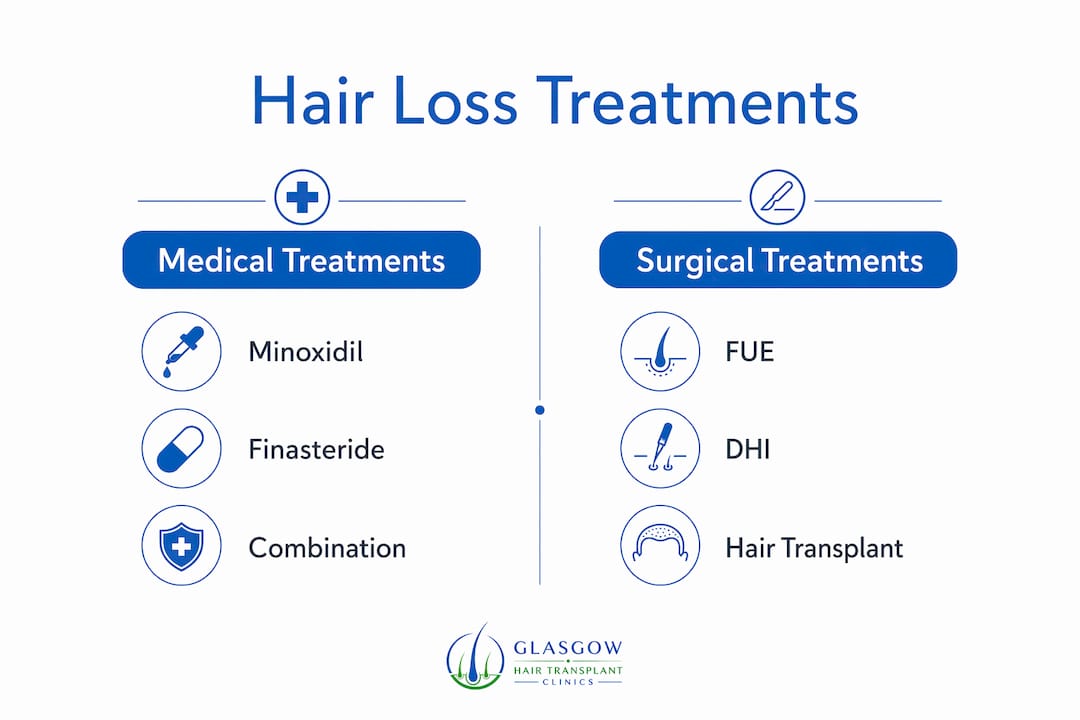
Minoxidil and finasteride are the two treatments with the strongest clinical evidence for androgenetic alopecia in the UK. Both are approved for use and referenced in NHS guidance, but they work through entirely different mechanisms.
Minoxidil prolongs the anagen(growth) phase and supports scalp follicle activity, while finasteride lowers dihydrotestosterone (DHT), the hormone responsible for follicle shrinkage. Targeting different biological pathways is precisely why combining them produces better results than either alone.

How effective is minoxidil?
Minoxidil reduces loss or promotes regrowth in approximately 62% of patients after one year of consistent use. That figure reflects patients who apply it twice daily without interruption. Stopping treatment reverses gains within months, so minoxidil is a long-term commitment rather than a short course.
Topical minoxidil is available over the counter in 2% and 5% formulations for both men and women in the UK. The 5% solution produces faster results in most patients. Oral minoxidil is also available but requires a prescription and medical supervision due to cardiovascular considerations.
How effective is finasteride?
Finasteride halts hair loss in 83–87% of men over two years, making it the most clinically effective medical option currently available. That effectiveness comes with an important caveat: finasteride is a prescription-only medicine for men, and it is not licensed for use in women of childbearing age.
The NHS rarely funds finasteride because it is classified as a cosmetic treatment. Most patients access it through private prescriptions, which require ongoing medical monitoring. Budget for regular review appointments when planning this route.
Comparing medical treatments at a glance
| Treatment | Availability | Best for | Typical result timeline |
|---|---|---|---|
| Topical minoxidil | Over the counter | Men and women, early to moderate loss | 3–6 months |
| Oral finasteride | Private prescription | Men with androgenetic alopecia | 6–12 months |
| Combination therapy | Prescription required | Men with moderate to advanced loss | 6–12 months |
| Topical finasteride | Prescription required | Men seeking reduced systemic exposure | 6–12 months |
Pro Tip: Set a calendar reminder for a six-month review with your prescriber. Patients who track progress with photographs are far more likely to stay adherent and catch early signs of side effects.
Combination therapy using both finasteride and minoxidil produces superior results to either treatment alone. The rationale is straightforward: minoxidil improves follicle blood flow while finasteride reduces the hormonal trigger for miniaturisation. Together, they address the condition from two directions simultaneously.
How do surgical options compare to medical treatments?
Surgery is the only option that permanently restores hair rather than simply slowing its loss. The most widely used technique in the UK is Follicular Unit Extraction (FUE), which removes individual follicular units from a donor area and implants them into thinning zones.
When is a hair transplant the right choice?
Surgery is recommended when medical treatments have produced insufficient results, or when hair loss is advanced enough that regrowth from medication alone is unlikely. Candidates need an adequate donor supply, typically from the back and sides of the scalp, to achieve a natural result.
The key criteria for surgical suitability are:
- Stable hair loss pattern for at least 12 months
- Sufficient donor density at the back and sides of the scalp
- Realistic expectations about coverage and density
- No active scalp conditions or uncontrolled medical issues
- Willingness to follow pre- and post-operative care protocols
Hair transplant surgery typically costs £3,000–£15,000 in the UK private sector, depending on the number of grafts required. The NHS does not fund hair transplants for androgenetic alopecia. That cost range reflects significant variation in clinic quality, surgeon experience, and graft count.
Pro Tip: Always verify that your surgeon is on the GMC register and that the clinic holds CQC registration before committing to surgery. These are non-negotiable markers of regulated, safe practice in the UK.
Post-surgical care is as important as the procedure itself. Patients should avoid strenuous activity for at least two weeks, protect the scalp from direct sun, and follow their clinic’s washing protocol precisely. You can read more about pre- and post-operative care to understand what the recovery period involves.
FUE is not the only surgical technique available. Direct Hair Implantation (DHI) uses a specialised implanter pen to place grafts without pre-made incisions, which can improve angle control and density. Follicular Unit Transplantation (FUT) removes a strip of scalp tissue and is less common today but remains suitable for patients needing high graft counts.
What natural and adjunct remedies are available?
The natural remedy market for hair loss is large and largely unregulated. Most products make claims that outpace their evidence base considerably.
Biotin supplements and caffeine shampoos lack strong clinical evidence and do not treat androgenetic alopecia effectively. Clinical guidelines do not recommend these as primary treatments. They may support general scalp health, but they will not reverse genetically driven hair loss.
The adjunct therapies with the most credible emerging evidence are:
- Platelet-Rich Plasma (PRP): Uses concentrated growth factors from your own blood to stimulate follicle activity. Results are promising but trial quality remains modest.
- Low-Level Laser Therapy (LLLT): Delivers photobiomodulation to the scalp via laser caps or clinic devices. Evidence suggests modest improvement in density when used consistently.
- Microneedling: Creates micro-injuries that may enhance topical minoxidil absorption and stimulate growth factors. Often used alongside medical treatment rather than independently.
- Ketoconazole shampoo: Has anti-androgenic properties and is used to reduce scalp inflammation. It is a useful adjunct but not a standalone solution.
PRP, LLLT, and microneedling have emerging but limited evidence as adjunct treatments. They are best viewed as supportive rather than primary solutions until stronger clinical evidence is available. Patients should maintain realistic expectations and prioritise licensed medical treatments first.
The practical role of these therapies is to complement a medical or surgical plan, not replace it. A patient using finasteride and minoxidil who adds PRP sessions may see improved density compared to medication alone. Using PRP as a standalone treatment for androgenetic alopecia, however, is unlikely to produce meaningful long-term results.
How do you choose the right hair loss treatment?
The correct treatment depends on the cause of your hair loss, not just its appearance. A professional clinical assessment is vital to identify the correct diagnosis, rule out underlying causes such as thyroid dysfunction or hormonal imbalance, and guide safe treatment selection. Starting treatment without a diagnosis risks wasting money and delaying effective care.
Reading through a consultation preparation guide before your appointment helps you arrive with the right information and questions ready.
The main factors that shape treatment choice are:
- Cause of loss: Androgenetic alopecia responds to finasteride and minoxidil. Alopecia areata requires different management entirely.
- Extent of loss: Early-stage loss responds well to medical treatment. Advanced loss may require surgery to achieve visible coverage.
- Sex and age: Finasteride is not suitable for women of childbearing age. Minoxidil is licensed for both sexes.
- Preference for oral versus topical: Some patients prefer topical applications to avoid systemic medication. Others find daily application impractical.
- Budget: Medical treatments are ongoing costs. Surgery is a single larger investment with permanent results.
| Treatment category | Best use case | Key benefit | Main limitation |
|---|---|---|---|
| Topical minoxidil | Early to moderate loss, men and women | Accessible, OTC, well-tolerated | Requires lifelong use |
| Oral finasteride | Moderate to advanced loss in men | High efficacy, once-daily tablet | Prescription only, side effect profile |
| FUE hair transplant | Advanced loss, stable pattern | Permanent, natural-looking result | High upfront cost, surgical risk |
| PRP / LLLT | Adjunct to medical treatment | Supports follicle health | Limited standalone evidence |
| Combination therapy | Men with moderate to advanced loss | Targets multiple pathways | Requires ongoing prescriber review |
Pro Tip: Do not self-diagnose and self-prescribe. A trichologist or dermatologist can identify whether your loss is androgenetic, reactive, or autoimmune. The treatment for each is completely different.
Marketing often oversimplifies hair loss solutions. A one-size-fits-all approach is rare in clinical practice. Ongoing review by a regulated prescriber is not optional. It is the mechanism by which your treatment plan stays safe and effective as your condition evolves.
Key takeaways
The most effective approach to hair loss is a clinically assessed, combination-based plan that matches treatment to the specific cause and stage of loss.
| Point | Details |
|---|---|
| Licensed treatments first | Minoxidil and finasteride have the strongest clinical evidence and should anchor any treatment plan. |
| Combination therapy outperforms monotherapy | Using both finasteride and minoxidil together targets hormonal and growth-cycle pathways simultaneously. |
| Surgery suits advanced cases | FUE hair transplantation is permanent but requires stable loss, adequate donor supply, and a regulated surgeon. |
| Adjuncts support, not replace | PRP, LLLT, and microneedling are best used alongside licensed treatments, not as standalone solutions. |
| Clinical assessment is non-negotiable | A professional diagnosis rules out underlying conditions and prevents costly, ineffective self-treatment. |
What I have learned from years of watching patients navigate hair loss
The single biggest mistake I see is patients spending months on unproven supplements before seeking a clinical opinion. By the time they arrive at a consultation, the window for early medical intervention has often narrowed. Minoxidil and finasteride work best when started early. Waiting for loss to become obvious before acting is the most common and most avoidable error.
The second pattern I notice is unrealistic expectations around surgery. A hair transplant does not stop ongoing loss in non-transplanted areas. Patients who have surgery without a concurrent medical plan often find themselves losing ground elsewhere within a few years. The best outcomes I have seen come from patients who combine FUE with ongoing finasteride use, treating the transplant as one component of a broader strategy rather than a complete solution.
Adjunct therapies like PRP are genuinely useful when positioned correctly. I have seen patients respond well to PRP treatment as part of a structured plan. What I have not seen is PRP alone reversing established androgenetic alopecia. The evidence simply does not support that outcome, and any clinic suggesting otherwise deserves scrutiny.
The most reassuring thing I can tell you is this: the treatments that work are well-established, accessible, and safe when managed properly. You do not need to spend a fortune on unproven products. You need an accurate diagnosis and a plan built around licensed, evidence-based options.
— Harley
Glasgowhairtransplantclinics: expert hair restoration in the UK
Glasgowhairtransplantclinics offers medically supervised hair restoration across Glasgow and the wider UK, with CQC-registered clinics and GMC-registered surgeons providing every procedure.
Whether you are considering FUE hair transplantation , PRP therapy , or Scalp Micro Pigmentation, the team at Glasgowhairtransplantclinics builds each plan around a thorough clinical assessment. Treatments are available at transparent, published prices with flexible payment options. A free consultation, available online or face to face, is the right first step for anyone ready to move from comparison to action. Request your consultation and receive a personalised treatment recommendation from a qualified specialist.
FAQ
What is the most effective medical treatment for hair loss in the UK?
Finasteride is the most clinically effective medical option, halting hair loss in 83–87% of men over two years. Combining it with minoxidil produces better results than either treatment alone.
Is a hair transplant available on the NHS?
Hair transplants for androgenetic alopecia are not funded by the NHS and are accessed privately. Costs in the UK typically range from £3,000 to £15,000 depending on the number of grafts required.
How long does it take to see results from minoxidil?
Most patients see measurable results from topical minoxidil within 3–6 months of consistent twice-daily use. Stopping treatment reverses any gains, so it requires long-term commitment.
Do natural remedies like biotin supplements work for hair loss?
Biotin supplements and caffeine shampoos lack strong clinical evidence for androgenetic alopecia and are not recommended as primary treatments by UK clinical guidelines. They may support general scalp health but will not reverse genetically driven hair loss.
When should I consider a hair transplant over medical treatment?
A hair transplant is appropriate when medical treatments have produced insufficient results or when hair loss is too advanced for medication to achieve visible coverage. A clinical assessment is required to confirm donor supply and suitability before proceeding.
Recommended
Certifications




What are the medically licensed treatments for hair loss?
Minoxidil and finasteride are the two treatments with the strongest clinical evidence for androgenetic alopecia in the UK. Both are approved for use and referenced in NHS guidance, but they work through entirely different mechanisms.
Minoxidil prolongs the anagen(growth) phase and supports scalp follicle activity, while finasteride lowers dihydrotestosterone (DHT), the hormone responsible for follicle shrinkage. Targeting different biological pathways is precisely why combining them produces better results than either alone.
How effective is minoxidil?
Minoxidil reduces loss or promotes regrowth in approximately 62% of patients after one year of consistent use. That figure reflects patients who apply it twice daily without interruption. Stopping treatment reverses gains within months, so minoxidil is a long-term commitment rather than a short course.
Topical minoxidil is available over the counter in 2% and 5% formulations for both men and women in the UK. The 5% solution produces faster results in most patients. Oral minoxidil is also available but requires a prescription and medical supervision due to cardiovascular considerations.
How effective is finasteride?
Finasteride halts hair loss in 83–87% of men over two years, making it the most clinically effective medical option currently available. That effectiveness comes with an important caveat: finasteride is a prescription-only medicine for men, and it is not licensed for use in women of childbearing age.
The NHS rarely funds finasteride because it is classified as a cosmetic treatment. Most patients access it through private prescriptions, which require ongoing medical monitoring. Budget for regular review appointments when planning this route.
Comparing medical treatments at a glance
| Treatment | Availability | Best for | Typical result timeline |
|---|---|---|---|
| Topical minoxidil | Over the counter | Men and women, early to moderate loss | 3–6 months |
| Oral finasteride | Private prescription | Men with androgenetic alopecia | 6–12 months |
| Combination therapy | Prescription required | Men with moderate to advanced loss | 6–12 months |
| Topical finasteride | Prescription required | Men seeking reduced systemic exposure | 6–12 months |
Pro Tip: Set a calendar reminder for a six-month review with your prescriber. Patients who track progress with photographs are far more likely to stay adherent and catch early signs of side effects.
Combination therapy using both finasteride and minoxidil produces superior results to either treatment alone. The rationale is straightforward: minoxidil improves follicle blood flow while finasteride reduces the hormonal trigger for miniaturisation. Together, they address the condition from two directions simultaneously.
How do surgical options compare to medical treatments?
Surgery is the only option that permanently restores hair rather than simply slowing its loss. The most widely used technique in the UK is Follicular Unit Extraction (FUE), which removes individual follicular units from a donor area and implants them into thinning zones.
When is a hair transplant the right choice?
Surgery is recommended when medical treatments have produced insufficient results, or when hair loss is advanced enough that regrowth from medication alone is unlikely. Candidates need an adequate donor supply, typically from the back and sides of the scalp, to achieve a natural result.
The key criteria for surgical suitability are:
- Stable hair loss pattern for at least 12 months
- Sufficient donor density at the back and sides of the scalp
- Realistic expectations about coverage and density
- No active scalp conditions or uncontrolled medical issues
- Willingness to follow pre- and post-operative care protocols
Hair transplant surgery typically costs £3,000–£15,000 in the UK private sector, depending on the number of grafts required. The NHS does not fund hair transplants for androgenetic alopecia. That cost range reflects significant variation in clinic quality, surgeon experience, and graft count.
Pro Tip: Always verify that your surgeon is on the GMC register and that the clinic holds CQC registration before committing to surgery. These are non-negotiable markers of regulated, safe practice in the UK.
Post-surgical care is as important as the procedure itself. Patients should avoid strenuous activity for at least two weeks, protect the scalp from direct sun, and follow their clinic’s washing protocol precisely. You can read more about pre- and post-operative care to understand what the recovery period involves.
FUE is not the only surgical technique available. Direct Hair Implantation (DHI) uses a specialised implanter pen to place grafts without pre-made incisions, which can improve angle control and density. Follicular Unit Transplantation (FUT) removes a strip of scalp tissue and is less common today but remains suitable for patients needing high graft counts.
What natural and adjunct remedies are available?
The natural remedy market for hair loss is large and largely unregulated. Most products make claims that outpace their evidence base considerably.
Biotin supplements and caffeine shampoos lack strong clinical evidence and do not treat androgenetic alopecia effectively. Clinical guidelines do not recommend these as primary treatments. They may support general scalp health, but they will not reverse genetically driven hair loss.
The adjunct therapies with the most credible emerging evidence are:
- Platelet-Rich Plasma (PRP): Uses concentrated growth factors from your own blood to stimulate follicle activity. Results are promising but trial quality remains modest.
- Low-Level Laser Therapy (LLLT): Delivers photobiomodulation to the scalp via laser caps or clinic devices. Evidence suggests modest improvement in density when used consistently.
- Microneedling: Creates micro-injuries that may enhance topical minoxidil absorption and stimulate growth factors. Often used alongside medical treatment rather than independently.
- Ketoconazole shampoo: Has anti-androgenic properties and is used to reduce scalp inflammation. It is a useful adjunct but not a standalone solution.
PRP, LLLT, and microneedling have emerging but limited evidence as adjunct treatments. They are best viewed as supportive rather than primary solutions until stronger clinical evidence is available. Patients should maintain realistic expectations and prioritise licensed medical treatments first.
The practical role of these therapies is to complement a medical or surgical plan, not replace it. A patient using finasteride and minoxidil who adds PRP sessions may see improved density compared to medication alone. Using PRP as a standalone treatment for androgenetic alopecia, however, is unlikely to produce meaningful long-term results.
How do you choose the right hair loss treatment?
The correct treatment depends on the cause of your hair loss, not just its appearance. A professional clinical assessment is vital to identify the correct diagnosis, rule out underlying causes such as thyroid dysfunction or hormonal imbalance, and guide safe treatment selection. Starting treatment without a diagnosis risks wasting money and delaying effective care.
Reading through a consultation preparation guide before your appointment helps you arrive with the right information and questions ready.
The main factors that shape treatment choice are:
- Cause of loss: Androgenetic alopecia responds to finasteride and minoxidil. Alopecia areata requires different management entirely.
- Extent of loss: Early-stage loss responds well to medical treatment. Advanced loss may require surgery to achieve visible coverage.
- Sex and age: Finasteride is not suitable for women of childbearing age. Minoxidil is licensed for both sexes.
- Preference for oral versus topical: Some patients prefer topical applications to avoid systemic medication. Others find daily application impractical.
- Budget: Medical treatments are ongoing costs. Surgery is a single larger investment with permanent results.
| Treatment category | Best use case | Key benefit | Main limitation |
|---|---|---|---|
| Topical minoxidil | Early to moderate loss, men and women | Accessible, OTC, well-tolerated | Requires lifelong use |
| Oral finasteride | Moderate to advanced loss in men | High efficacy, once-daily tablet | Prescription only, side effect profile |
| FUE hair transplant | Advanced loss, stable pattern | Permanent, natural-looking result | High upfront cost, surgical risk |
| PRP / LLLT | Adjunct to medical treatment | Supports follicle health | Limited standalone evidence |
| Combination therapy | Men with moderate to advanced loss | Targets multiple pathways | Requires ongoing prescriber review |
Pro Tip: Do not self-diagnose and self-prescribe. A trichologist or dermatologist can identify whether your loss is androgenetic, reactive, or autoimmune. The treatment for each is completely different.
Marketing often oversimplifies hair loss solutions. A one-size-fits-all approach is rare in clinical practice. Ongoing review by a regulated prescriber is not optional. It is the mechanism by which your treatment plan stays safe and effective as your condition evolves.
Key takeaways
The most effective approach to hair loss is a clinically assessed, combination-based plan that matches treatment to the specific cause and stage of loss.
| Point | Details |
|---|---|
| Licensed treatments first | Minoxidil and finasteride have the strongest clinical evidence and should anchor any treatment plan. |
| Combination therapy outperforms monotherapy | Using both finasteride and minoxidil together targets hormonal and growth-cycle pathways simultaneously. |
| Surgery suits advanced cases | FUE hair transplantation is permanent but requires stable loss, adequate donor supply, and a regulated surgeon. |
| Adjuncts support, not replace | PRP, LLLT, and microneedling are best used alongside licensed treatments, not as standalone solutions. |
| Clinical assessment is non-negotiable | A professional diagnosis rules out underlying conditions and prevents costly, ineffective self-treatment. |
What I have learned from years of watching patients navigate hair loss
The single biggest mistake I see is patients spending months on unproven supplements before seeking a clinical opinion. By the time they arrive at a consultation, the window for early medical intervention has often narrowed. Minoxidil and finasteride work best when started early. Waiting for loss to become obvious before acting is the most common and most avoidable error.
The second pattern I notice is unrealistic expectations around surgery. A hair transplant does not stop ongoing loss in non-transplanted areas. Patients who have surgery without a concurrent medical plan often find themselves losing ground elsewhere within a few years. The best outcomes I have seen come from patients who combine FUE with ongoing finasteride use, treating the transplant as one component of a broader strategy rather than a complete solution.
Adjunct therapies like PRP are genuinely useful when positioned correctly. I have seen patients respond well to PRP treatment as part of a structured plan. What I have not seen is PRP alone reversing established androgenetic alopecia. The evidence simply does not support that outcome, and any clinic suggesting otherwise deserves scrutiny.
The most reassuring thing I can tell you is this: the treatments that work are well-established, accessible, and safe when managed properly. You do not need to spend a fortune on unproven products. You need an accurate diagnosis and a plan built around licensed, evidence-based options.
— Harley
Glasgowhairtransplantclinics: expert hair restoration in the UK
Glasgowhairtransplantclinics offers medically supervised hair restoration across Glasgow and the wider UK, with CQC-registered clinics and GMC-registered surgeons providing every procedure.
Whether you are considering FUE hair transplantation , PRP therapy , or Scalp Micro Pigmentation, the team at Glasgowhairtransplantclinics builds each plan around a thorough clinical assessment. Treatments are available at transparent, published prices with flexible payment options. A free consultation, available online or face to face, is the right first step for anyone ready to move from comparison to action. Request your consultation and receive a personalised treatment recommendation from a qualified specialist.
FAQ
What is the most effective medical treatment for hair loss in the UK?
Finasteride is the most clinically effective medical option, halting hair loss in 83–87% of men over two years. Combining it with minoxidil produces better results than either treatment alone.
Is a hair transplant available on the NHS?
Hair transplants for androgenetic alopecia are not funded by the NHS and are accessed privately. Costs in the UK typically range from £3,000 to £15,000 depending on the number of grafts required.
How long does it take to see results from minoxidil?
Most patients see measurable results from topical minoxidil within 3–6 months of consistent twice-daily use. Stopping treatment reverses any gains, so it requires long-term commitment.
Do natural remedies like biotin supplements work for hair loss?
Biotin supplements and caffeine shampoos lack strong clinical evidence for androgenetic alopecia and are not recommended as primary treatments by UK clinical guidelines. They may support general scalp health but will not reverse genetically driven hair loss.
When should I consider a hair transplant over medical treatment?
A hair transplant is appropriate when medical treatments have produced insufficient results or when hair loss is too advanced for medication to achieve visible coverage. A clinical assessment is required to confirm donor supply and suitability before proceeding.

About the author
Dr Harpreet Kalra is a GP and hair-transplant surgeon at Glasgow Hair Transplant Clinics. His consultations consider the diagnosis, donor area, existing hair and likely future pattern before treatment is discussed.
Compare hair loss treatment options
Our Glasgow team can assess your diagnosis and explain which medical or surgical options are suitable for you.
Book a Free Consultation