★★★★★
“Excellent overall service.”
Paul Bassoo
Google review
FUE is a method of hair transplantation in which individual follicular units are removed from the donor area rather than taking a strip of scalp. Those grafts can then be used to rebuild areas affected by thinning or established hair loss.
The quality of an FUE procedure depends on much more than the number of grafts removed. Donor density, the pattern of hair loss, hair calibre, recipient-site design and how much donor hair should be preserved for the future all influence the treatment plan.
Book a Free Consultation




FUE is used to obtain individual follicular units from suitable areas of donor hair, normally around the back and sides of the scalp. Instead of removing one continuous strip of donor tissue, the follicular units are taken individually and the extraction sites are distributed through the donor region.
Once harvested, those follicles can be transplanted into the hairline, temples, frontal scalp, mid-scalp or crown. The harvesting method may be the same, but the way the grafts are distributed changes considerably from one part of the scalp to another.
Hairline work usually relies heavily on finer single-hair grafts at the leading edge before stronger follicular units are introduced behind them. Crown restoration is different because the placement has to follow the patient's existing vertex whorl. Larger areas of thinning also require more careful decisions about where the available donor hair will have the greatest visual effect.
FUE avoids the single linear donor scar associated with strip harvesting, but it should not be described as scar-free. Each harvested follicular unit leaves a small healing site in the donor region, so the distribution and total amount of extraction matter to the final appearance of the donor area.
At Glasgow Hair Transplant Clinics, FUE planning therefore begins with the donor area as well as the area the patient wants restored. You can read more about that part of the assessment in our donor-area guide.
An FUE procedure begins with the donor region. The back and sides of the scalp are examined to identify the areas where suitable follicular units can be harvested while leaving enough surrounding density for the donor area to retain a natural appearance.
Individual follicular units are then released from the surrounding skin and removed one at a time. Hair does not travel beneath the scalp at exactly the same angle in every patient, so extraction has to follow the individual anatomy of the follicle rather than assuming that every graft sits vertically beneath the skin.
Harvesting is spread through the donor region. Concentrating too many extractions in one small area can create visible thinning even when each individual extraction mark is small. The aim is to obtain the grafts needed for the recipient area while keeping the remaining donor hair balanced.
The extracted follicular units are then prepared for transplantation. Natural grafts contain different numbers of hairs. Single-hair units are particularly useful where a soft hairline edge is required, while stronger multi-hair units can contribute more density farther behind the hairline or through other parts of the scalp.
Recipient sites are planned according to the area being restored. Hairline work requires control of angle, direction and irregularity so that the front does not look uniformly implanted. Work through the crown follows a completely different pattern because the grafts have to turn around the patient's vertex whorl.
The prepared follicular units are then placed into those recipient sites. Graft spacing and direction are determined by the existing hair and the amount of coverage being created rather than by trying to place the largest possible number of grafts into the smallest possible area.
This is why two FUE procedures with a similar graft count can still involve very different planning. The quality and distribution of the available donor hair, the treatment area and the patient's longer-term pattern of hair loss all affect how those grafts should be used.
The donor region is not an unlimited supply of replacement hair. Once a follicular unit has been removed for transplantation, it is no longer available to provide density in that part of the donor scalp or to be used in another procedure later.
FUE leaves many small extraction sites rather than the single linear wound associated with FUT. As these sites heal and the surrounding donor hair grows, the individual marks can become difficult to notice, but this does not make FUE a scar-free procedure.
The overall appearance depends partly on how much hair was present before surgery and how the extractions were distributed. Dense donor hair can tolerate a different level of harvesting from a donor region that is already relatively fine or sparse.
Overharvesting is a different problem from the visibility of an individual scar. Removing too high a proportion of follicles can leave the donor region looking permanently thin, particularly when the hair is worn short. Good planning therefore concentrates on what should safely remain as much as what can be removed.
This becomes increasingly important where a patient has extensive hair loss or may want another transplant later. The donor assessment should take the lifetime pattern into account rather than using the maximum possible graft number during the first procedure.
Our hair transplant donor-area guide explains this in more detail.
FUE can be used across a wide range of hair-loss patterns, but suitability is determined by the donor area rather than simply by the size of the bald or thinning region. A patient with a strong donor region and a defined treatment area presents a different situation from somebody with diffuse thinning across both the recipient and donor scalp.
At the front of the scalp, FUE can provide the different graft types needed to rebuild a receding hairline or temples. Fine individual hairs can soften the leading edge while stronger units are positioned farther back where they contribute more to density.
FUE can also be used through the mid-scalp and crown. These larger areas often place greater demands on the donor supply, so the issue is not simply whether FUE can technically reach the area. The graft requirement has to remain sensible for the amount of donor hair available.
Patients who have undergone previous transplant surgery can sometimes have further FUE work, although the remaining donor region needs to be examined carefully. Previous FUE extraction or a previous FUT scar both change what is available for another operation.
There are also cases where surgery should not be rushed. Weak donor hair, extensive diffuse thinning or rapidly changing hair loss may make the proposed restoration unrealistic at that point in time.
FUE, DHI and FUT are often presented as though they are three completely separate solutions to the same problem. In practice, the terms describe different parts of the harvesting and implantation process.
FUE refers to individual donor harvesting. Follicular units are removed separately rather than from a strip of donor scalp. Once prepared, those grafts still have to be positioned into carefully designed recipient sites.
With DHI, donor follicles are commonly obtained using FUE-style individual harvesting. The distinction is mainly at implantation, where an implanter device is used to place prepared grafts. DHI therefore does not make FUE irrelevant; the two can form different stages of the same procedure.
FUT obtains donor follicles from a strip of scalp that is subsequently separated into individual follicular-unit grafts. It produces a linear donor scar but remains a valid harvesting option for selected patients.
Technique should follow the donor area, graft requirement, hairstyle, previous surgery and treatment plan. Choosing a method purely because one name is marketed as newer or more advanced does not determine the eventual result.
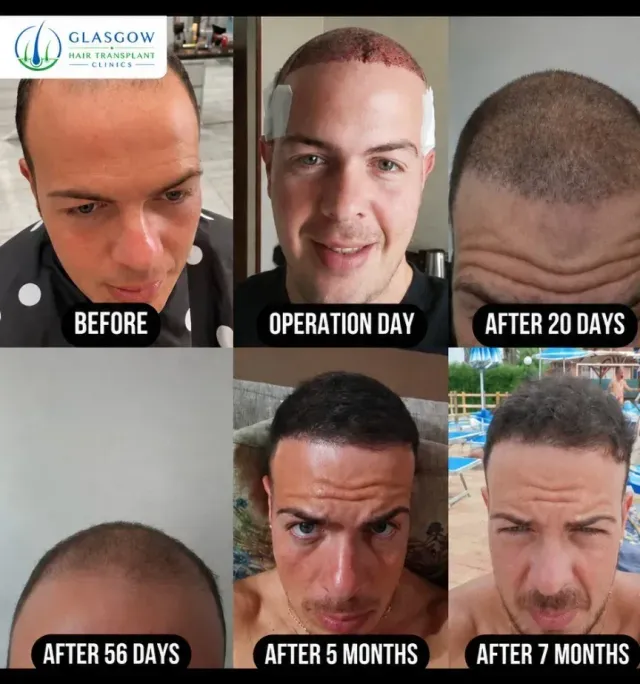
Immediately after FUE, both the donor and recipient areas are visible. The donor region shows the individual extraction sites while small crusts form around the transplanted grafts. Redness, tenderness and some swelling can occur during this early stage.
As the first week progresses, the scalp begins to settle. The extraction sites in the donor region close and the recipient area starts losing the freshly treated appearance. Washing and early aftercare should follow the instructions supplied after treatment rather than trying to remove crusting aggressively.
A few weeks later, many of the transplanted hair shafts can shed. This is one of the stages patients are most likely to worry about because the treated area can temporarily appear thinner again. The visible shaft has fallen, but the transplanted follicle remains beneath the skin and begins another growth cycle.
There is then a period when relatively little appears to happen before new hairs begin emerging. Early growth can be fine, uneven and different in texture from the mature result. Individual follicles do not all start growing on the same day.
Through the middle part of the first year, more of the transplanted hair becomes visible and earlier hairs gain length and calibre. Hairline work can become easier to assess during this period, while larger mid-scalp and crown procedures may still have a significant amount of development ahead.
Maturation continues through the remainder of the first year and can carry on beyond that point. The finished appearance depends on the starting pattern, graft distribution, hair characteristics and the amount of native hair remaining around the transplant.
More information is available in our aftercare guide, hair transplant shedding guide and hair transplant timeline.
FUE procedures vary considerably in size. Rebuilding a limited area of frontal recession can involve far fewer grafts than restoring the hairline, frontal scalp and mid-scalp together. Extensive crown loss creates another set of demands because of the surface area involved.
A quotation therefore needs to follow an assessment of the treatment area and donor region. Hair calibre, donor density, previous transplant surgery and the amount of existing hair all affect what can realistically be achieved with a given number of grafts.
Graft count on its own is not a useful measure of value. Two patients can receive a similar number of follicular units while starting with very different hair-loss patterns and donor characteristics. Where those grafts are placed and how well the donor supply is managed are equally important.
Current information is available on our hair transplant cost page and no-deposit scheme.
Transplanted donor follicles and the patient's existing native hair should not be treated as though they are the same resource. A transplant can restore selected areas, but it does not prevent non-transplanted hair from continuing to thin later.
This matters particularly when treatment is carried out early in the progression of pattern hair loss. A very low frontal hairline or heavy use of donor grafts in one procedure can make later restoration more difficult if recession subsequently moves farther back.
The donor region therefore needs to be considered as a lifetime resource. A strong result now should not depend on using hair that may be needed more effectively elsewhere in future.
Patients who retain significant native hair can also discuss longer-term management separately from surgery. More information is available in our hair-loss medication guide.
Book a Free ConsultationFUE planning starts with the relationship between the donor and recipient areas. The aim is not to remove the largest number of grafts possible, but to decide how the available donor hair can be used to create a sensible improvement while retaining options for the future.
Dr Harpreet Kalra will also consider the pattern beyond the area the patient currently wants treated. A receding hairline, developing mid-scalp thinning and crown loss can all compete for the same donor supply, so those areas need to be considered together before grafts are allocated.
Dr Kalra is registered with the General Medical Council under reference 7126076.
Read About Dr Kalra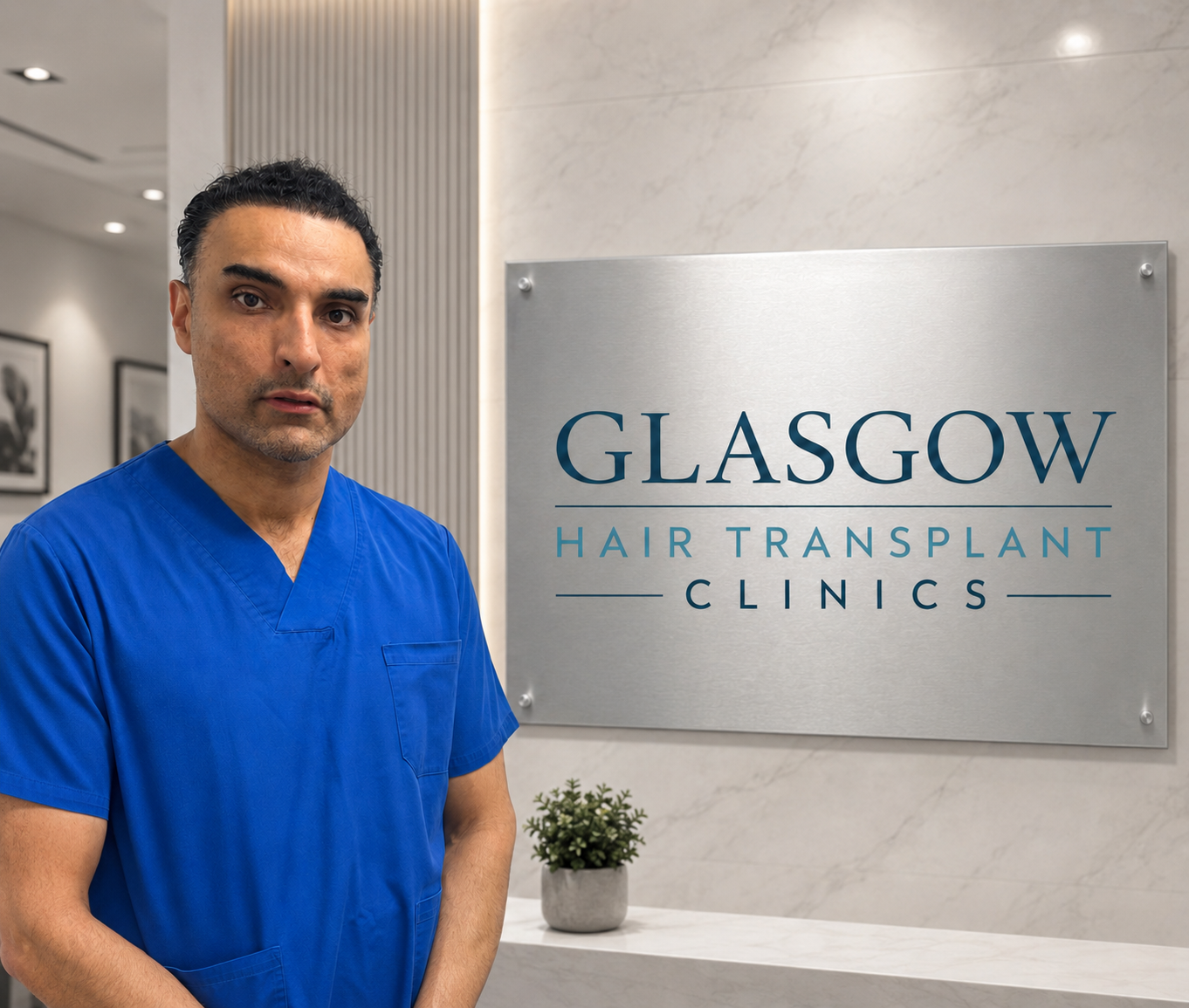
FUE is a surgical donor-harvesting method in which follicular units are removed individually from suitable donor hair and then transplanted into areas affected by thinning or hair loss.
FUE avoids the continuous linear scar associated with FUT, but it is not scar-free. Each extraction creates a small healing site within the donor area.
They do not describe exactly the same part of a transplant. FUE relates to donor harvesting, while DHI usually refers to an implanter-based placement method. The appropriate approach depends on the treatment plan.
Neither donor method is automatically better for every patient. FUE avoids a linear donor scar, while FUT can still be useful in selected cases. Donor characteristics, graft requirements and hairstyle all affect the decision.
Yes. FUE grafts can be used for suitable hairline and temple restoration, with different follicular-unit types positioned according to the hairline design.
Yes. Crown restoration can be carried out with FUE in suitable patients, although larger vertex areas can require significant donor planning and graft placement needs to follow the natural crown whorl.
Yes. Transplantation relocates selected donor follicles but does not stop surrounding non-transplanted hair from continuing to thin.
Transplanted hair shafts commonly shed during the early weeks. New growth develops gradually over the following months and continues maturing through the first year and, in some areas, beyond it.
Cost depends on the treatment area, donor characteristics, estimated graft requirement and complexity of the plan. See our hair transplant cost page for current pricing information.
Glasgow Hair Transplant Clinics is based at Tay House on Bath Street, close to Charing Cross in Glasgow city centre. The clinic is well positioned for patients travelling from across Glasgow, the surrounding Central Belt and other parts of Scotland.
Glasgow Hair Transplant Clinics
Tay House
300 Bath Street
Glasgow
G2 4JR
Tay House sits towards the western side of Glasgow city centre, close to Charing Cross and within the main commercial area around Bath Street and Sauchiehall Street. The central location makes it straightforward to reach by public transport as well as by car.
If you are travelling by public transport:
If you are travelling by car, Glasgow city centre can be reached from the M8. Public car parks and on-street parking are available around Bath Street, Sauchiehall Street and Charing Cross. Allow some additional time before your consultation for city-centre traffic and parking.
Tay House is also surrounded by hotels, cafés, shops and other city-centre facilities, which can be useful if a friend or family member is accompanying you to your appointment.
Book a consultation to discuss the area you want to restore, the strength of your donor hair and how the available follicular units can be planned across the hairline, frontal scalp, mid-scalp or crown.
Book a Free Consultation