★★★★★
“Excellent overall service.”
Paul Bassoo
Google review

Direct Hair Implantation, or DHI, uses a specialist implanter pen to place individual hair follicles directly into areas affected by permanent hair loss.
Treatment planning with Dr Harpreet Kalra considers donor density, hair calibre, existing hair, the area being restored and the precise angle, direction and distribution required for a natural-looking result.
Book a Free Consultation




DHI is a hair transplant method in which individual donor follicles are extracted, prepared and implanted into the recipient area with a specialist pen-shaped device. The implanter creates the opening and places the graft in one controlled movement.
Each follicular unit is positioned according to the planned depth, angle and direction of growth. This makes the method particularly useful around a hairline, through temple points, between existing hairs and across the changing directions of a crown whorl.
DHI does not create additional donor hair. The final plan depends on the number and quality of follicles available around the back and sides of the scalp, the surface area being treated and the amount of native hair that remains.
A DHI implanter is a slim instrument with a hollow tip and a plunger mechanism. A prepared follicular unit is loaded into the tip before the device is positioned against the recipient scalp.
The implanter introduces the follicle at the selected point and releases it beneath the skin. This process is repeated for every graft according to the distribution designed before surgery.
Fine single-hair grafts are used through the leading edge of a hairline, while stronger multi-hair units can add greater visual density farther behind it.
DHI can restore a receding hairline, temple corners, frontal thinning, the mid-scalp or the crown. The method can also be used for carefully planned beard and eyebrow restoration.
Frontal work follows the design principles explained on our hairline transplant page, while vertex restoration requires the separate whorl planning described on our crown hair transplant page.
DHI begins with an assessment of the hair-loss pattern, donor area, existing recipient hair and the part of the scalp the patient wants to restore. This determines whether surgery is suitable before the final graft number is agreed.
Hairline height, temple shape, central direction and the transition into existing hair are planned before any graft is implanted.
The donor area is shortened so individual follicular units can be identified clearly. Local anaesthetic is used before selected units are released with a fine circular punch and removed one at a time.
Extraction is distributed across the donor zone to obtain the required grafts without concentrating removal into one patch or leaving the surrounding hair visibly depleted.
Each follicular unit is checked after extraction and kept protected while it is outside the scalp. Grafts are sorted according to their quality and the number of hairs they contain.
Single-hair units are reserved for the front edge of a hairline, while stronger multi-hair units are positioned farther behind to create greater visual coverage.
A prepared follicular unit is introduced into the hollow tip of the implanter. Several implanters can be prepared in rotation so each graft can be matched to the intended part of the recipient design.
The loaded pen is positioned at the selected recipient point. The tip enters at the planned angle and depth before the plunger releases the follicular unit into its new position.
This movement is repeated across the treatment area. A frontal hairline requires a low forward direction, while crown restoration must rotate around the patient's existing whorl.
Once implantation is complete, the donor and recipient areas are checked. Written aftercare explains how to sleep, wash the scalp and protect the new grafts during early healing.
DHI uses individual follicular units taken from suitable donor hair around the back and sides of the scalp. Each extracted unit leaves a small circular healing point rather than one continuous linear scar.
The appearance of the donor area depends on how many follicles are removed, how evenly extraction is distributed, skin response, donor density and surrounding hair length.
Overharvesting occurs when too many follicular units are removed or extraction is concentrated too heavily through particular parts of the donor region.
This can leave permanent patchiness or visible thinning across the back and sides. Reaching a high graft number is not a successful plan if the donor area is left depleted.
Extraction should be planned within hair expected to remain stable. Removing follicles from areas that may thin later can reduce the long-term reliability of those grafts.
The amount of shaving depends on the donor area, recipient area and graft requirement. The donor hair is commonly shortened so individual follicles can be identified and extracted accurately.
In some procedures, recipient hair can remain longer while grafts are implanted between it. Other procedures require more trimming to provide clear access across a larger area.
Some patients can undergo another DHI procedure, but the remaining donor density must be reassessed before further grafts are removed.
Our hair transplant donor area guide explains safe harvesting, density and overharvesting in greater detail.
DHI suitability depends on the cause and pattern of hair loss, the strength of the donor area, the recipient surface and the amount of existing hair that remains.
DHI provides close control over the position and direction of individual grafts, which is important where the central hairline changes into the temple corners.
Fine single-hair grafts can be distributed along the leading edge before stronger units are positioned behind them.
DHI can be used where native hair remains within the recipient area. Grafts are positioned according to the available spaces and the direction of surrounding follicles.
DHI can restore the mid-scalp or crown where the donor supply is suitable. Crown placement must follow the patient's vertex whorl rather than one straight growth direction.
DHI can be used for suitable female-pattern hair loss and where the patient wants to retain more length through the recipient area. Donor stability remains essential where thinning is diffuse.
Surgery should not be rushed where donor density is weak, hair loss is changing rapidly, thinning affects the donor region, scalp disease is active or the requested coverage cannot be supported by the available follicles.
Where significant native hair remains, longer-term treatment can be discussed separately. See our hair-loss medication guide.
DHI, FUE and FUT are separate hair transplant treatment options. Each uses donor follicles to restore permanent hair loss, but the surgical method, donor healing pattern and implantation process differ.
DHI uses a specialist implanter pen to introduce each prepared follicular unit directly into the recipient area. The opening and graft placement are completed in one controlled movement.
FUE hair transplantation removes individual follicular units from the donor area before recipient sites are prepared and the grafts are placed into those openings.
FUT hair transplantation obtains donor follicles from a narrow strip of scalp which is divided into individual follicular-unit grafts.
FUT leaves a linear donor scar, while DHI and FUE leave individual circular donor extraction sites.
Donor selection, recipient design, graft handling, follicular-unit choice, angle, direction, distribution and aftercare all affect the finished appearance.
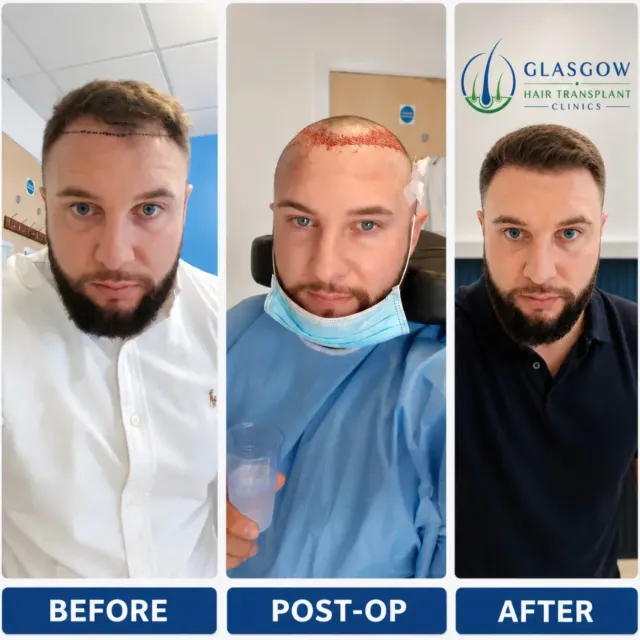
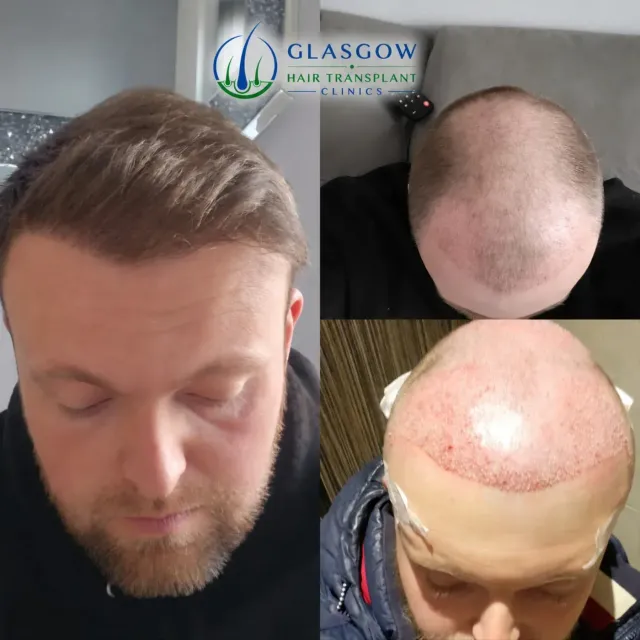
Immediately after DHI, the donor area shows individual extraction points and the recipient area contains the newly implanted grafts. Redness, tenderness, crusting and some swelling can occur during this early stage.
The early priority is to protect the implanted follicles from rubbing, scratching and unnecessary pressure. Washing and handling should follow the written instructions supplied after treatment.
Many transplanted hair shafts shed during the weeks after surgery. Shedding of the visible shaft does not mean the transplanted follicle beneath the skin has been lost.
Our hair transplant shedding guide explains this stage in more detail.
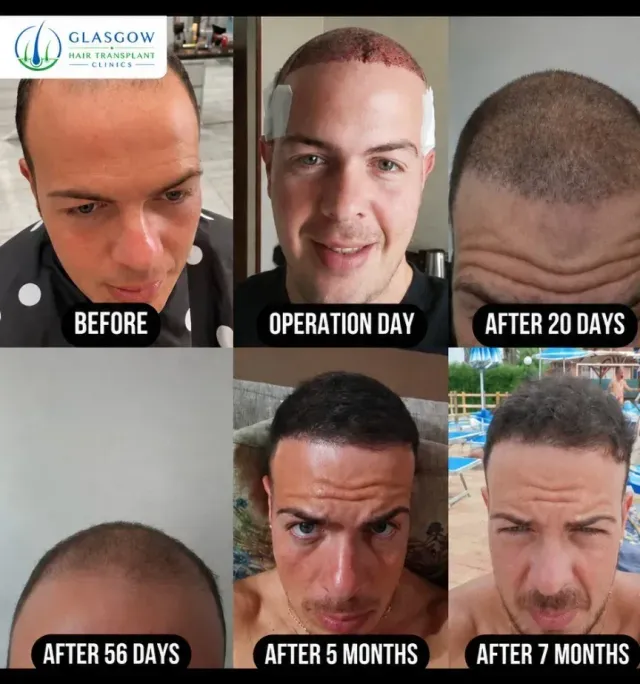
New growth usually begins from around the third or fourth month. Early hairs can appear fine and uneven because the transplanted follicles do not all begin active growth at the same time.
Coverage becomes more noticeable through the middle and later parts of the first year. Final maturation is commonly assessed around 12 months and can continue towards 18 months.
See our hair transplant timeline and hair transplant aftercare guide for the complete recovery sequence.
Potential problems include bleeding, infection, swelling, temporary numbness, folliculitis, shock loss, visible scarring, poor graft growth, donor thinning and an unnatural recipient pattern.
DHI hair transplant procedures in Glasgow typically cost £3,000–£5,000, depending on the treatment area, graft requirement, donor characteristics and complexity of the surgical plan.
A limited temple or hairline procedure involves a different amount of surgery from rebuilding the complete frontal region, extending treatment into the mid-scalp or restoring a substantial crown.
Current pricing information is available on our hair transplant cost page.
The graft number depends on the size and shape of the treatment area, the amount of native hair remaining, donor density, hair calibre and the level of coverage being planned.
Two patients receiving the same number of grafts can have very different procedures. A frontal restoration concentrates follicles into a smaller region, while a broad crown spreads them over a larger surface.
The main pricing factors are the graft requirement, treatment area, existing hair, previous transplant surgery and the complexity of the recipient design.
DHI redistributes donor follicles but does not stop non-transplanted hair elsewhere on the scalp from continuing to thin. Donor hair should therefore be preserved for possible future treatment.
Patients can also read about our no-deposit scheme.
DHI planning starts with the relationship between the donor area, existing hair and the part of the scalp being restored.
Dr Harpreet Kalra assesses donor density, hair calibre, the likely pattern of future loss and how many follicles can be committed without weakening the back and sides.
Recipient planning includes hairline height and shape, temple direction, crown-whorl movement, graft selection and the distribution required to blend with surrounding growth.
Dr Kalra is registered with the General Medical Council under reference 7126076.
Read About Dr Kalra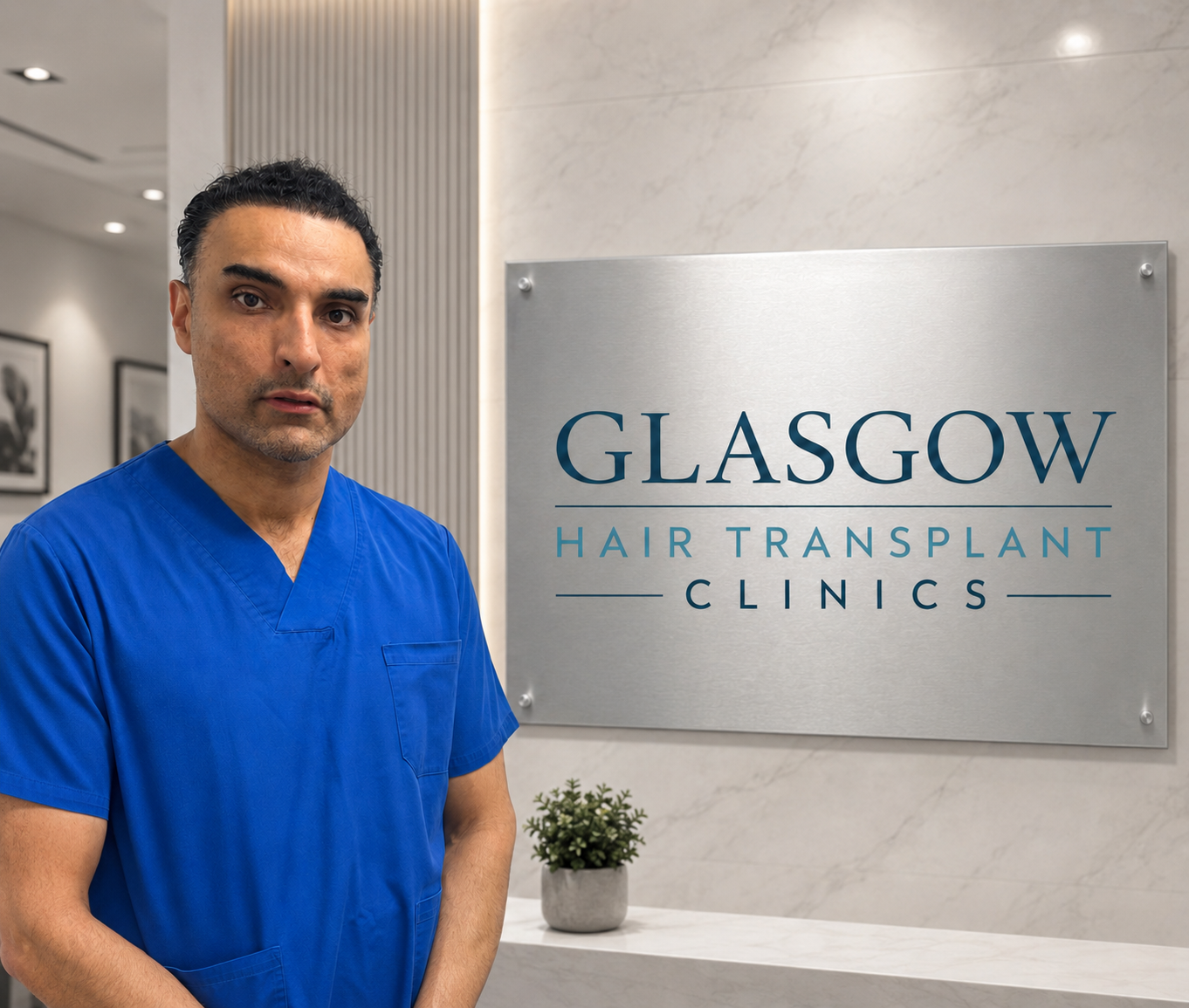
Glasgow Hair Transplant Clinics is based at Tay House on Bath Street, close to Charing Cross in Glasgow city centre.
Glasgow Hair Transplant ClinicsPatients travelling by car can approach Glasgow city centre from the M8. Public car parks and on-street parking are available around Bath Street and Charing Cross.
DHI uses a specialist implanter pen to place prepared donor follicles directly into the recipient area.
The pen holds a follicular unit inside a hollow tip and places it according to the planned depth, direction and angle.
DHI uses an implanter pen for direct placement. FUE uses individually prepared recipient sites before the grafts are inserted.
The donor area is commonly shortened. The amount of recipient-area trimming depends on the graft number and treatment area.
Yes. DHI can restore a suitable receding hairline and temple corners using carefully selected follicular units.
Yes. Crown placement must follow the patient's natural vertex whorl and remain realistic for the available donor supply.
New growth usually begins from around the third or fourth month and continues developing through the first year.
DHI procedures typically cost £3,000–£5,000, depending on graft requirements and treatment complexity.