
Crown Hair Transplant Glasgow
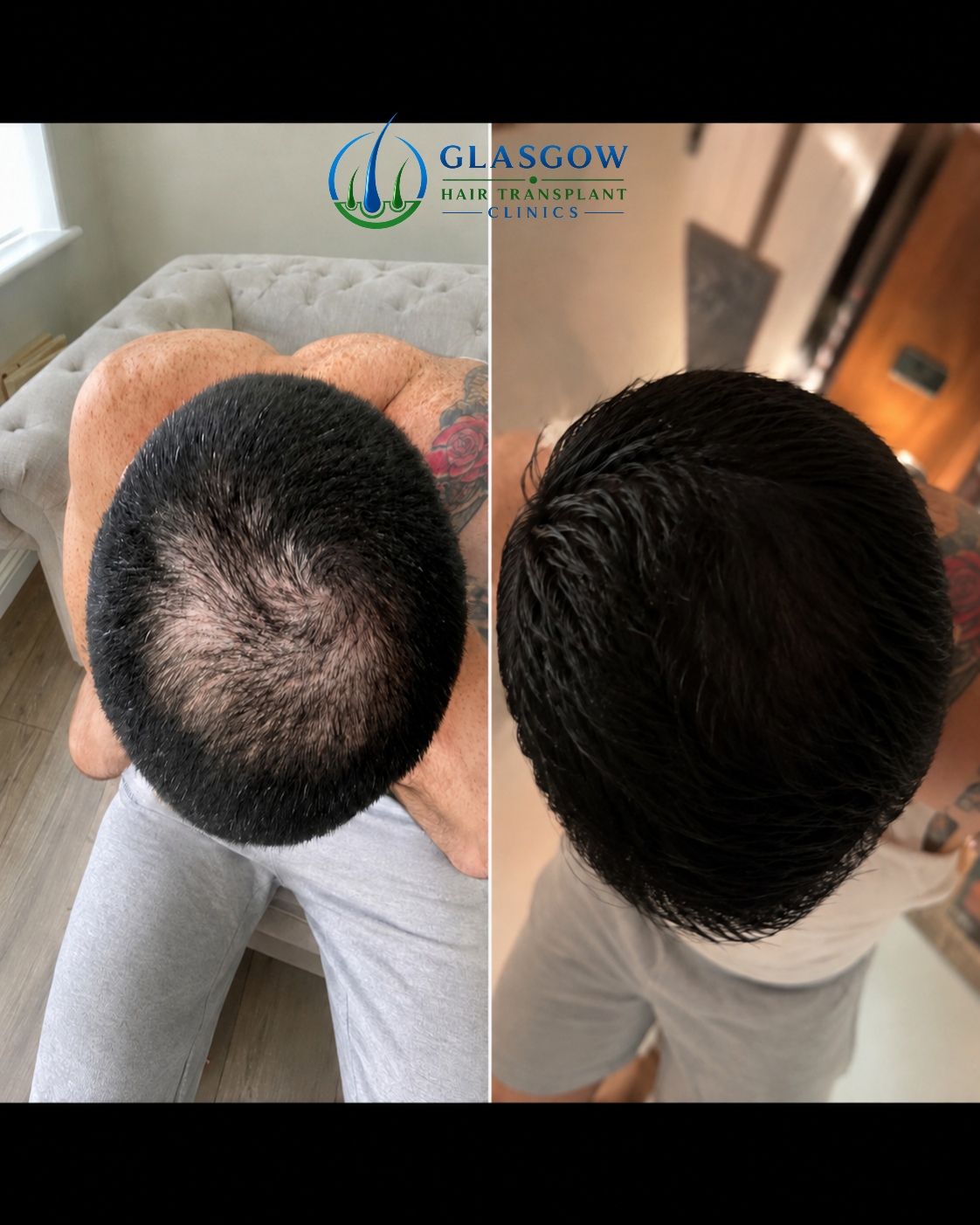
Crown thinning can be deceptively difficult to restore. The vertex sits at the back of the scalp, where the hair rotates around a natural whorl rather than growing uniformly in one direction.
A successful crown transplant therefore involves more than filling the visible thin patch. Dr Harpreet Kalra considers the size of the crown, existing hair, the natural whorl pattern and the amount of donor hair available when planning treatment.




Crown Hair Transplant in Glasgow
The crown, or vertex, is the rounded area towards the back of the scalp. Hair loss here may begin as a small area of reduced density before gradually widening into a more obvious circular or oval pattern.
Crown restoration involves moving suitable follicular units from the donor area into this thinning region. The aim is not simply to cover visible scalp. Grafts have to be positioned so they follow the patient's natural crown pattern and make sensible use of the available donor supply.
The amount of work required can vary considerably. Some patients retain a substantial amount of native hair through the crown and need additional coverage between it. Others have a much wider area where most of the original density has already been lost.
That difference is important because the crown can use a significant number of grafts. The treatment plan therefore needs to consider the vertex alongside the hairline, mid-scalp and the likelihood of further hair loss rather than treating the crown as an isolated patch.
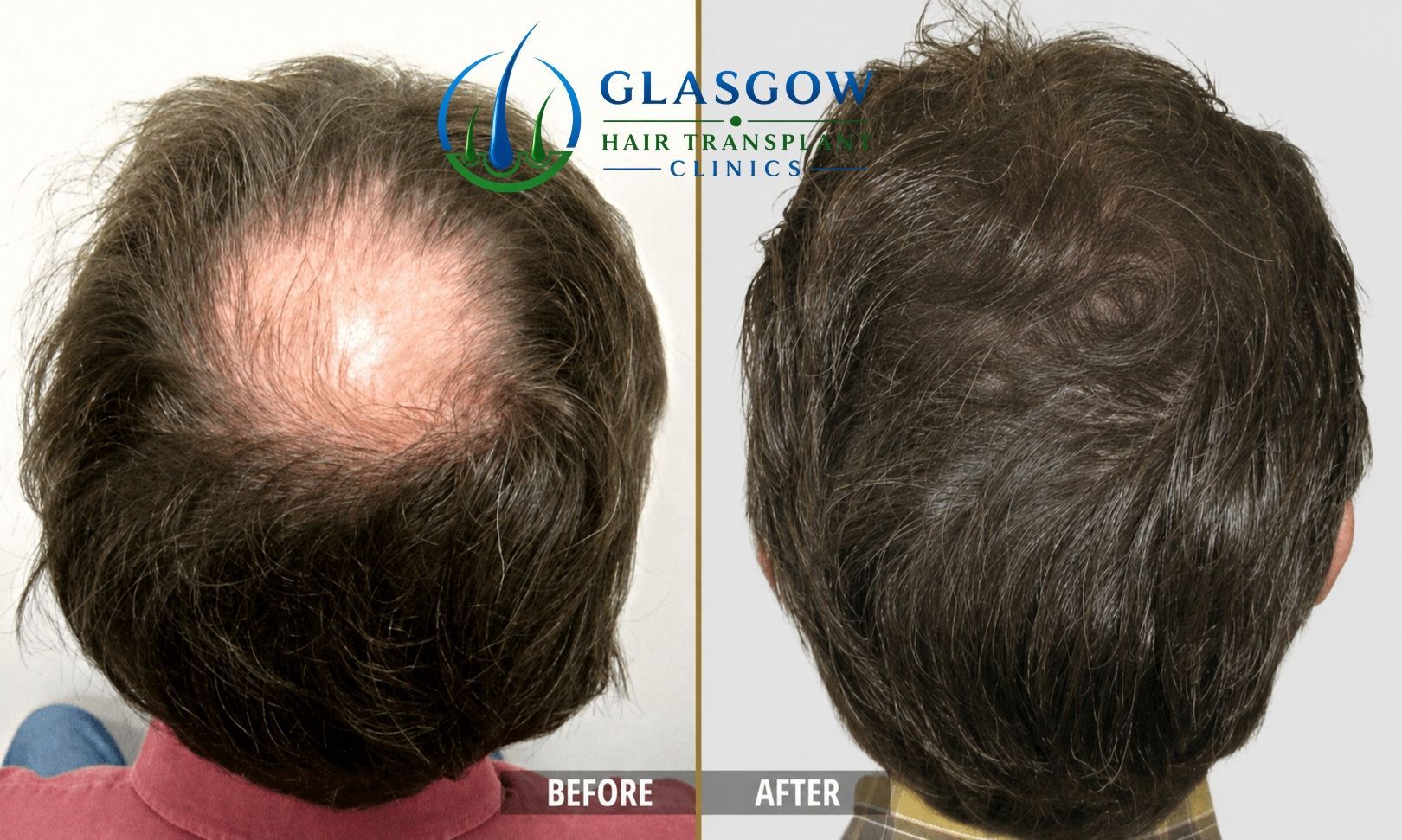
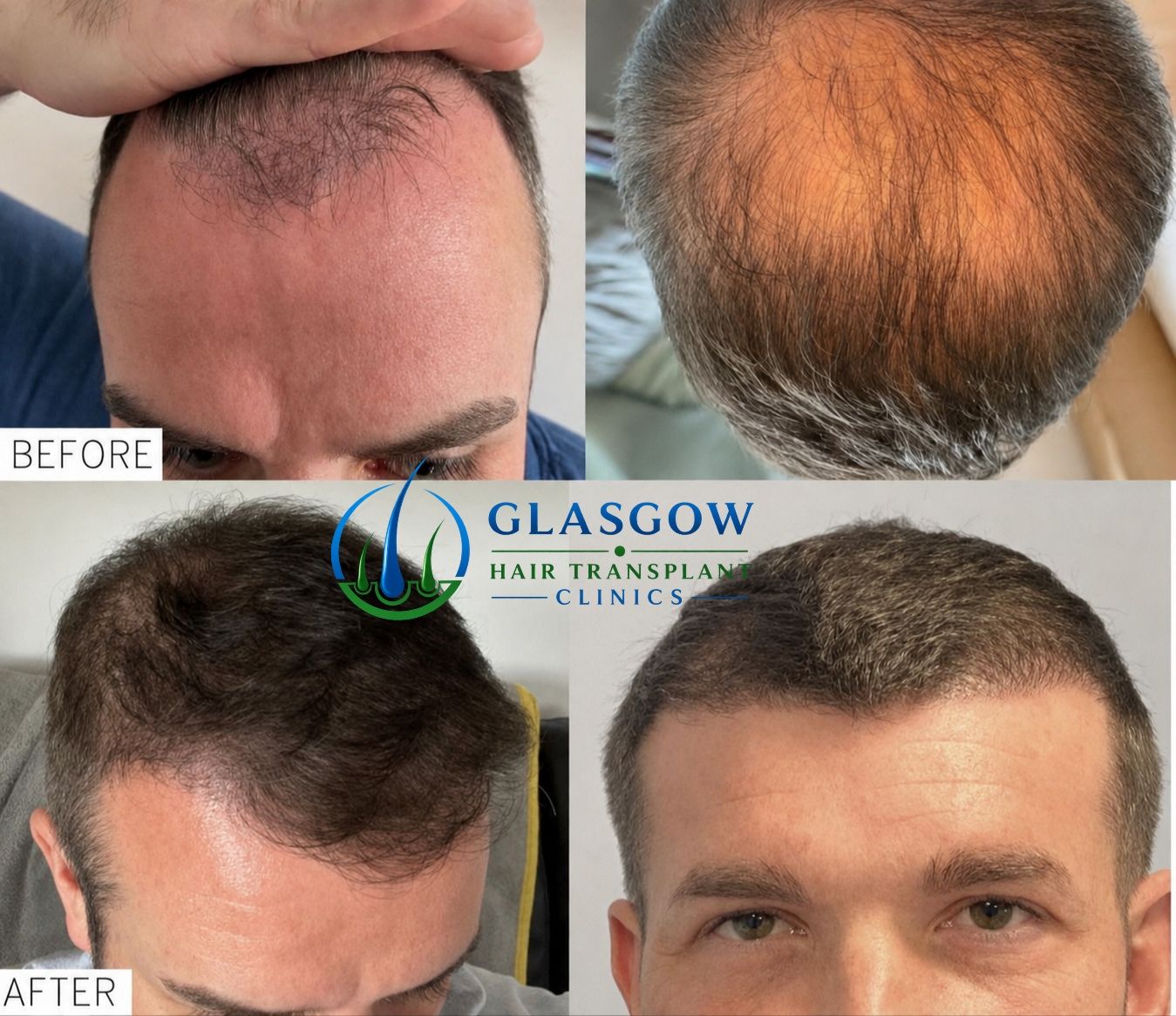
Why the Crown Is Different from Other Hair Loss Areas
The crown is not simply another part of the scalp that can be approached in the same way as a receding hairline. At the front of the head, the direction of the existing hair is usually easier to follow. Around the vertex, the pattern is more complex. Hair turns around a central whorl and gradually changes direction and angle as it moves away from that point.
That natural pattern matters during transplantation. The recipient sites have to work with the surviving crown hair rather than cutting across it. Even where the centre of the vertex has become noticeably thin, hairs around the edge of the area can often reveal how the original whorl was arranged. Rebuilding that pattern is an important part of making transplanted hair sit naturally once it has grown.
Crown loss also has a tendency to extend beyond the area that first becomes noticeable. A patient may initially see a relatively small patch under overhead lighting, while thinning is already developing more gradually around it and towards the mid-scalp. Treating only the most obvious central area without considering what is happening around it can leave the transplant looking isolated if the native hair continues to recede.
The shape of the head makes assessment more difficult as well. The vertex is a curved surface, so a photograph taken directly from above does not always show the true amount of scalp involved. Once the crown is examined from different angles, the treatment area can be wider than it appeared in a single photograph. That has a direct effect on how many grafts may be needed and how much density can realistically be created.
For that reason, crown restoration has to be considered alongside the rest of the scalp. The size of the vertex, existing density, the natural whorl, the strength of the donor area and any thinning through the hairline or mid-scalp all influence the final plan. The objective is to improve the crown without using donor hair in a way that restricts sensible options later if the pattern of hair loss continues to develop.
Crown Density and Graft Planning
Crown procedures can use a surprising amount of donor hair. The vertex is broad, curved and often wider than it appears in a photograph, so the area being restored can be considerably larger than a frontal hairline.
Graft numbers are worked out from the actual treatment area rather than from a standard crown figure. The size of the thinning zone, how much native hair remains, donor density, hair calibre and the contrast between the hair and scalp all affect how much coverage can realistically be created.
A patient with a small central crown and good surrounding density may need a very different plan from somebody whose thinning runs from the vertex forward into the mid-scalp. The second case can involve a much larger surface and may require the treatment to be staged rather than attempting to restore everything at once.
Donor supply also has to be protected. Hair removed from the donor region for the crown is no longer available for future work at the hairline, temples or mid-scalp. This matters particularly in younger patients or anyone whose frontal loss is still developing.
Before recommending a graft number, we therefore look at the crown diameter, retained native density and the strength of the donor area alongside the rest of the scalp.
The Vertex Whorl and Graft Placement
Crown hair normally rotates around a central whorl. Even when the middle of the vertex has become thin, the surviving hairs around the edge often show where that original pattern begins and how the hair naturally travels across the scalp.
That pattern guides recipient-site placement. Hair near the centre can emerge more upright, while the angle becomes flatter as the grafts move away from the whorl. The direction also changes gradually around the vertex rather than following one fixed line.
Getting that direction right matters just as much as graft density. A crown can have good growth but still look unnatural if the transplanted hairs sit against the patient's existing pattern instead of following it.
Crown or Hairline First?
Patients do not always lose hair in one area at a time. It is common to see recession at the front alongside thinning through the crown, and this is where donor planning becomes particularly important. Treating both areas may be possible, but it does not automatically mean both should be tackled at the same time.
The frontal hairline usually has the greater effect on how somebody looks from day to day because it frames the face. If the donor supply is limited, using a large number of grafts in the crown first can reduce what remains available for the front later. For that reason, the hairline often receives priority when both areas require substantial restoration.
That is not a fixed rule. Someone with a strong frontal hairline and a clearly established area of crown loss may have little reason to postpone vertex treatment. The decision is different again in a patient whose hair loss has been stable for years and whose donor area is strong enough to support work in more than one region.
The useful approach is to look at the scalp as a whole. Crown size, frontal recession, mid-scalp density, age, donor strength and the likely direction of future loss all matter before grafts are allocated. Patients considering frontal treatment can also read about hairline restoration.
Choosing the Technique for Crown Restoration
The crown does not require one particular transplant method. The important part is how the donor hair is harvested, how many usable grafts are available and how those grafts will be positioned through the changing direction of the vertex.
With FUE, follicular units are removed individually from the donor area. This is commonly used where the required graft number can be obtained without concentrating extraction too heavily in one part of the donor region. The same grafts can then be placed through the crown according to the patient's natural whorl.
DHI changes the implantation stage rather than the basic principle of donor harvesting. An implanter device can be useful in selected cases, particularly where native crown hair remains and individual placement has to work between existing follicles.
FUT is another option where strip harvesting suits the donor area and the number of grafts required. It leaves a linear donor scar, so hairstyle preference and previous surgery also form part of that discussion.
Technique is therefore decided after the crown and donor area have been assessed, not before. A well-planned FUE, DHI or FUT procedure can all be appropriate in the right patient; the treatment name on its own does not determine the quality of the crown result.
Crown Hair Transplant Recovery
The crown usually settles in much the same way as other transplanted areas of the scalp. Immediately after surgery the recipient area will be visible, with small crusts around the newly placed grafts and some redness or tenderness. At this stage the priority is simply to leave the grafts alone and follow the washing and aftercare instructions provided by the clinic.
During the first week the appearance begins to calm down. The small crusts gradually loosen as the skin heals, although the crown can still look noticeably different from the surrounding scalp. Patients should avoid scratching or rubbing the area while this early healing is taking place.
Once the initial healing has passed, many of the transplanted hairs will shed. This often causes concern because the crown can temporarily look thinner again, but the visible hair shaft and the follicle beneath the skin are not the same thing. The follicle remains in place while it moves through its normal growth cycle.
New growth is gradual. Early hairs may start to become noticeable after the first few months, usually appearing fine and uneven at the beginning. Different follicles start growing at different times, so it is normal for one part of the crown to seem further ahead than another during the early stages.
As the months pass, more of the transplanted hair becomes visible and the earlier growth gains length and thickness. This is also when the shape of the restored whorl becomes easier to see. Crown results should not be judged too early, particularly where a larger area has been treated.
Development continues through the first year and can carry on beyond that point as individual hairs mature. The final appearance will depend on the number of grafts used, the amount of native crown hair, hair calibre and the size of the area that was restored.
More detailed information is available in our hair transplant aftercare guide, shedding guide and hair transplant timeline.
Crown Hair Transplant Cost in Glasgow
There is a wide variation in the size of a crown procedure. Some patients still have plenty of native hair through the vertex and only need additional coverage through the thinner areas. Others have lost most of the hair across the crown and may also be thinning into the mid-scalp.
Those two situations cannot sensibly be priced in the same way. Before a quotation is given, the treatment area has to be measured and the donor region examined. Hair calibre and existing density also matter because the same number of grafts does not produce the same visual coverage in every patient.
Crown work can become graft-heavy once the thinning area becomes broad. Where the required number begins to compete with future hairline or mid-scalp needs, the plan may need to be adjusted or split into stages. That discussion comes before deciding how much surgery to carry out.
Current pricing is explained on our hair transplant cost page. Patients looking at payment arrangements can also read about the no-deposit option.
Who Is Suitable for a Crown Hair Transplant?
A visible crown does not automatically mean it should be transplanted immediately. One of the first things we look at is how the hair loss has been behaving. A crown that has changed very little over several years is easier to plan than one that has become noticeably wider over the previous twelve months.
The donor area then has to be considered against the size of the job. A patient with dense donor hair and isolated vertex loss presents a very different case from somebody who has a large crown, a receding frontal hairline and limited donor density. In the latter situation, using too much donor hair at the back of the scalp can create problems if frontal restoration is wanted later.
Age and the wider pattern of hair loss also influence the decision. In a younger patient with active thinning, it may be sensible to see how the pattern develops before committing a large graft number to the crown. Patients with a more established pattern can often be planned with greater confidence because there is a clearer picture of which areas are likely to require treatment.
Existing crown hair is important too. Where substantial native density remains, treatment may be aimed at strengthening selected areas rather than filling the entire vertex. Where very little native hair remains, the discussion is more about how much coverage can realistically be created from the donor supply available.
For patients who still have a significant amount of native hair, longer term management can also be discussed separately through our hair-loss medication guide.
Book a Free ConsultationCrown Hair Transplant Planning With Dr Kalra
Crown restoration has to be planned alongside the wider pattern of hair loss. The amount of native hair remaining through the vertex, the position of the natural whorl and the strength of the donor area all influence how much work can reasonably be carried out.
Dr Harpreet Kalra will also consider what is happening through the frontal and mid-scalp areas. Where hair loss is present in more than one region, the available donor supply needs to be used in a way that leaves sensible options if further treatment is needed later.
Dr Kalra is registered with the General Medical Council under reference 7126076.
Frequently Asked Questions
What is a crown hair transplant?
A crown hair transplant moves suitable follicles from the donor area into thinning areas around the vertex. The grafts are positioned to work with the natural direction of the patient's crown rather than simply filling the visible patch.
Why is crown restoration different from hairline surgery?
Crown hair grows around a whorl and changes direction as it moves across the scalp. The treatment area can also be relatively broad, so both placement and donor use need to be planned differently from a frontal hairline.
How many grafts might be needed for the crown?
It varies considerably. The size of the vertex, the amount of native hair still present, donor density, hair calibre and the level of coverage being planned all influence the graft requirement.
Should the crown or hairline be treated first?
That depends on the wider pattern of hair loss and the available donor supply. Where both areas need substantial work, the frontal scalp often receives priority, although there are patients for whom crown-first or combined treatment makes more sense.
Can FUE be used for crown restoration?
Yes. FUE can be used to harvest individual follicular units for the crown where the donor area and required graft number make it a suitable approach.
Can DHI be used for the crown?
It can. DHI refers to an implanter-based placement method and may be considered in selected cases, including procedures where grafts need to be positioned around existing crown hair.
Can my existing crown hair continue thinning after surgery?
Yes. A transplant relocates donor follicles but does not stop surrounding non-transplanted hair from changing later. This is one reason the wider pattern of hair loss is considered before surgery.
When will growth from a crown transplant become visible?
The transplanted hairs commonly shed during the early weeks before new growth begins over the following months. Coverage develops gradually through the first year and crown results can continue maturing beyond twelve months.
How much does a crown hair transplant cost in Glasgow?
The cost depends on the size of the crown, the amount of existing hair, the estimated graft requirement and the treatment plan. Current pricing is explained on our hair transplant cost page .
How to Get to Our Glasgow Clinic
Glasgow Hair Transplant Clinics is based at Tay House on Bath Street, close to Charing Cross in Glasgow city centre. The clinic can be reached easily from across Glasgow and the wider Central Belt by train, subway, bus or car.
Glasgow Hair Transplant Clinics
Tay House
300 Bath Street
Glasgow
G2 4JR
Tay House is positioned towards the western side of Glasgow city centre, between Charing Cross and the central shopping and commercial districts. Bath Street runs through the city centre and is within walking distance of Sauchiehall Street and the surrounding business area.
If you are travelling by public transport:
- Train: Charing Cross railway station is the closest rail station to Tay House. Patients arriving through Glasgow Central or Glasgow Queen Street can continue towards Bath Street on foot, by local bus or by taxi.
- Subway: Buchanan Street Subway provides another convenient route into the centre. From Buchanan Street, continue west through the city centre towards Bath Street and Charing Cross.
- Bus: Bath Street, Sauchiehall Street and the surrounding streets are served by regular local bus routes, with stops within walking distance of Tay House.
Patients travelling by car can reach Glasgow city centre from the M8. Public car parks and on-street parking are available around Bath Street, Sauchiehall Street and Charing Cross. Allow additional time for city-centre traffic and parking before your appointment.
The city-centre location also means there are hotels, cafés, shops and other facilities close to Tay House if somebody is accompanying you to your consultation.
Glasgow Google reviews
Considering a Crown Hair Transplant in Glasgow?
Book a consultation to discuss the size of the crown, the existing vertex pattern, donor supply and how crown restoration fits with the wider pattern of hair loss across the scalp.
Book a Free Consultation