
Glasgow Hair Transplant Clinics · Hair loss advice
Male pattern baldness
A changing hairline can leave you unsure what to do next. Understand hereditary thinning, explore the treatment options and discuss your own pattern of loss with our Glasgow clinic.
Request a Consultation Explore treatment options ↓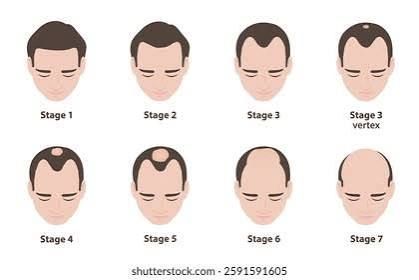




Male pattern baldness is the gradual thinning of hair around the temples, hairline and crown. Its medical name is androgenetic alopecia. The follicles in affected areas start producing finer, shorter hairs, so the scalp becomes easier to see even before a distinct bald patch develops.
The British Association of Dermatologists describes it as the most common form of hair loss in men. It can begin after puberty and usually changes over years. The pace varies: early temple recession does not tell you exactly how much hair you will eventually lose.
You may want to preserve the hair you have, improve an established area of recession, or simply understand what is happening. An assessment can help separate those aims. Treatment is a choice, and choosing to leave a receding hairline alone is also reasonable.
How common is hereditary thinning?
Alopecia UK estimates that pattern hair loss affects around half of men over 50. This includes different degrees of thinning, from a receding hairline to more extensive loss. It does not mean that half of men in that age group have lost all the hair on top of their head.
Some men notice changes in their late teens or twenties; others first become aware of them much later. Family members can develop different patterns and progress at different speeds. A relative’s hairline is useful background for a consultation, but it cannot provide a timetable for your own.
Our UK hair loss facts and statistics page looks at prevalence in more detail, including the differences between hereditary thinning, temporary shedding and alopecia areata.
What you might notice first
The pattern of change often tells you more than the number of hairs in the shower. Look at the hairline and crown over time, and note whether the scalp itself feels or looks different.
Changes around the temples and hairline
The corners above the temples may move backwards, leaving a more prominent central forelock. Some men first notice that a familiar hairstyle no longer covers the corners as easily. A slightly higher adult hairline can remain stable, so a single photograph cannot show whether recession is continuing.
More scalp showing at the crown
The natural whorl on top of the head can become more visible as density falls. Wet hair and strong overhead light also expose more scalp. Compare photographs with similar hair length, lighting and camera position before judging the amount of change. The clinic’s crown hair transplant guide explains how this area is assessed when surgery is being considered.
Hair that feels finer or gives less coverage
Hair may feel less substantial through the front or top, with a mixture of thick and much finer strands. A parting can look wider, or the hair may offer less coverage when combed back. Follicle miniaturisation also shortens the growth phase, which helps explain why some hairs no longer grow as long as neighbouring strands.
Shedding or scalp changes that need checking
The NHS describes losing 50–100 hairs a day as normal. Finding loose hairs alone does not diagnose male pattern baldness. Sudden heavy shedding, sharply defined patches, persistent soreness or scaling should be assessed for other causes, even if you also have a receding hairline.
Why the hair becomes finer
DHT and sensitive follicles
Dihydrotestosterone, usually shortened to DHT, is made from testosterone by an enzyme called 5-alpha reductase. In genetically susceptible scalp follicles, the response to DHT contributes to progressive miniaturisation. With successive growth cycles, those follicles produce smaller hairs and provide less coverage.
Normal androgen levels can be enough for this to happen. Male pattern baldness does not, by itself, prove that someone has unusually high testosterone. The Endotext review of male androgenetic alopecia describes how the hair cycle and follicle structure change in affected areas.
Inheritance from both sides of the family
Several genes influence susceptibility. The idea that baldness comes only from your mother’s side is too simple; inherited factors can come from either parent. Brothers can therefore have different hairlines, and the absence of an obviously bald parent does not rule out hereditary thinning. DermNet’s explanation of inheritance also notes that genetic tests cannot reliably predict an individual’s future baldness.
When another cause adds to the thinning
A stressful event or illness can trigger a separate episode of shedding. This may make existing pattern thinning more noticeable, but the two processes should be assessed separately. Significant weight loss, iron deficiency and some medicines can also affect hair. Tell the clinician about recent changes in your health and treatment; do not stop prescribed medication on your own.
Understanding your Norwood stage
The Hamilton–Norwood Scale describes the familiar combination of frontal recession and crown loss. It helps record the current pattern and compare it at later appointments.
Stages 1–3: hairline and early crown changes
Stage 1 shows little or no recession. Stage 2 describes limited movement at the temples. At stage 3, frontal recession is more established; the stage 3 vertex pattern includes crown loss. These descriptions concern the shape of the loss, rather than the amount of hair shed each day.
Stages 4–5: larger areas of loss
Both the front and crown are more affected, with a bridge of hair remaining between them. At stage 5 that bridge is narrower or less dense. A plan needs to consider how the areas may change together.
Stages 6–7: extensive loss across the top
The frontal and crown areas have joined, leaving hair mainly around the back and sides. At stage 7 the remaining fringe is narrower. The scale cannot determine transplant suitability or an exact graft requirement: those decisions also depend on examination of the remaining donor hair.
Could it be another kind of hair loss?
“Alopecia” means hair loss; it is not a single diagnosis. Men can have more than one type at the same time. Our alopecia guide explains the wider group of conditions.
Androgenetic Alopecia
Male pattern baldness is the gradual thinning of hair around the temples, hairline and crown. Its medical name is androgenetic alopecia. The follicles in affected areas start producing finer, shorter hairs, so the scalp becomes easier to see even before a distinct bald patch develops.
Telogen effluvium
This causes increased shedding across the scalp when more hairs than usual enter the resting phase. It can follow illness, an operation, major stress or marked weight loss, often with a delay of a few months. The BAD’s telogen effluvium leaflet explains why the trigger may have passed before the shedding becomes obvious. Recovery depends on the cause, and restoring visible volume takes time as new hairs grow.
Alopecia areata
Alopecia areata is an autoimmune condition that often produces smooth, round or oval patches. It can affect the beard, eyebrows or other body hair as well as the scalp. Its course and treatments differ from those of hereditary thinning. A new bald patch needs a diagnosis before treatment is chosen.
Traction alopecia
Repeated tension from tight hairstyles can damage hair around the areas being pulled. Traction alopecia may improve when the tension is removed early, but prolonged pulling can permanently damage the follicles. Looser styling is an essential part of managing the cause.
Anagen effluvium
Some cancer treatments interrupt actively growing hairs and can cause rapid loss. The extent and likelihood of regrowth depend on the treatment. Cancer Research UK explains these changes and the support available. Hair-loss care during cancer treatment should be discussed with the treating team.
Scarring alopecia and scalp disease
Inflammatory conditions such as lichen planopilaris can destroy follicles and leave permanent loss. Redness, burning, pain or scale around thinning areas are reasons to seek medical assessment. Specialist treatment aims to control the disease; a hair transplant cannot treat active inflammation.
Getting the diagnosis right
A clinician asks when the changes began, whether loss has been gradual or sudden, and what you have already tried. They examine the distribution of thinning and the condition of the scalp. Family history, recent illness, diet changes and current medicines can all help explain the picture.
A close examination may reveal variation in hair thickness that is difficult to see in ordinary photographs. If the appearance is typical, a clinical examination may be sufficient. The American Academy of Dermatology describes when blood tests or a scalp biopsy may help investigate another suspected cause.
Tests should answer a clinical question. For example, symptoms or widespread shedding may prompt investigation of iron status or thyroid function. The British Thyroid Foundation explains that significant thyroid dysfunction can cause diffuse hair loss. There is no single blood test that predicts how far a receding hairline will progress.
Choosing a treatment approach
Treatment may aim to slow continuing loss, improve the thickness of existing hair or make thinning less noticeable. The choice depends on the diagnosis and your health, as well as the result you want. The clinic’s hair-loss medication page explains how a treatment review is arranged.
Options for maintaining existing hair
Finasteride tablets
Finasteride reduces the conversion of testosterone to DHT. It is prescribed for suitable men with male pattern hair loss and may slow progression or improve growth. The NHS finasteride guidance advises that some improvement may be seen after three to six months. Continued treatment is generally needed to maintain the benefit.
Possible side effects include sexual difficulties, depression and suicidal thoughts. Sexual side effects may persist after stopping. Discuss any history of depression or suicidal thoughts with the prescriber before treatment. The MHRA’s May 2026 safety advice says that people taking finasteride 1 mg should stop it and contact a healthcare professional as soon as possible if depression or suicidal thoughts develop. Sexual side effects should also be reported to the prescriber.
Topical minoxidil
Minoxidil applied to the scalp can help some people maintain hair or achieve regrowth. It needs regular use according to the product instructions, with results assessed over months. The BAD advises allowing six to twelve months to judge the benefit. Irritation, dryness or itching can occur, and shedding may temporarily increase when treatment begins. Benefits are usually lost after treatment stops.
Oral minoxidil
A clinician may consider oral minoxidil off-label for selected patients. This means it is being used outside its UK licence for hair loss. It requires a prescription and a review of medical history, other medicines and cardiovascular risk.
Unwanted facial or body hair, headache, fluid retention and effects on blood pressure or heart rate need discussing. A 2024 randomised trial comparing oral and topical minoxidil did not establish that oral treatment was superior overall after 24 weeks. Tablets are therefore not automatically the better option.
Combined treatment
Finasteride and minoxidil work differently, so a clinician may discuss using them together. Adding treatments also adds practical commitments and possible side effects. Agree what improvement is being measured, how long the trial will last and when the prescription will be reviewed.
Platelet-rich plasma (PRP)
PRP treatment uses a portion of your blood prepared to concentrate platelets, which is injected into the scalp. It may be discussed for selected cases of pattern thinning. It does not redistribute follicles in the way a transplant does.
The research is mixed. A small placebo-controlled study by Gentile and colleagues reported improved hair density, whereas a later placebo-controlled pilot study did not find a significant objective benefit. Preparation methods and treatment schedules vary. Ask about the likely benefit for your starting point, repeat visits, discomfort and total cost before choosing a course.
Camouflage and choosing no treatment
A different haircut, a hairpiece or cosmetic fibres can change the appearance of thinning without trying to alter follicle growth. These options can be useful whether or not medication is suitable. You can also decide that treatment is not something you want to pursue.
Restoring coverage with donor hair
A hair transplant moves selected follicles from a suitable donor area, usually at the back and sides, into areas that have lost coverage. It does not create an unlimited new supply of hair. The amount that can be moved safely has to be balanced against the area you want to restore.
FUE: individual follicular unit extraction
FUE removes follicular units separately through small circular incisions. It leaves small individual scars rather than one continuous donor scar. Extraction needs to be spread appropriately: taking too much from one region can leave lasting visible thinning at the back or sides.
FUT: strip harvesting
FUT removes a strip of donor scalp that is divided into follicular-unit grafts. It leaves a linear scar. It remains an option in selected circumstances, with the decision influenced by donor characteristics, previous surgery and the hairstyle you expect to wear.
DHI: placing the grafts
DHI usually describes implantation with an implanter device. The grafts may still have been collected using FUE. Ask how the donor hair will be harvested and how the grafts will be placed; the label alone does not establish the quality of the result.
Who may be suitable?
Suitability depends on the cause of the loss, the health and density of donor hair, the rate of change and the coverage being requested. The AAD’s transplant guidance explains why younger men may be advised to wait and consider medical treatment first. Rapidly changing loss can make a permanent hairline difficult to plan.
A hairline transplant and crown restoration use the same finite donor supply. A consultation should explain which area has priority and what coverage is realistic. Our donor area guide covers the assessment in more detail.
Recovery, growth and possible complications
Transplanted hair often sheds in the early weeks before new growth appears. The NHS gives around four months as a usual starting point for new hair, with full results taking about ten to eighteen months. Your own recovery and growth may differ.
Surgery can cause bleeding, infection, swelling, noticeable scarring or poor graft growth. Follow the clinic’s washing and activity instructions while the grafts heal. Read the aftercare guide and recovery timeline before arranging time away from work. The cost page explains what to discuss when comparing a proposed treatment plan.
A Glasgow patient’s progress
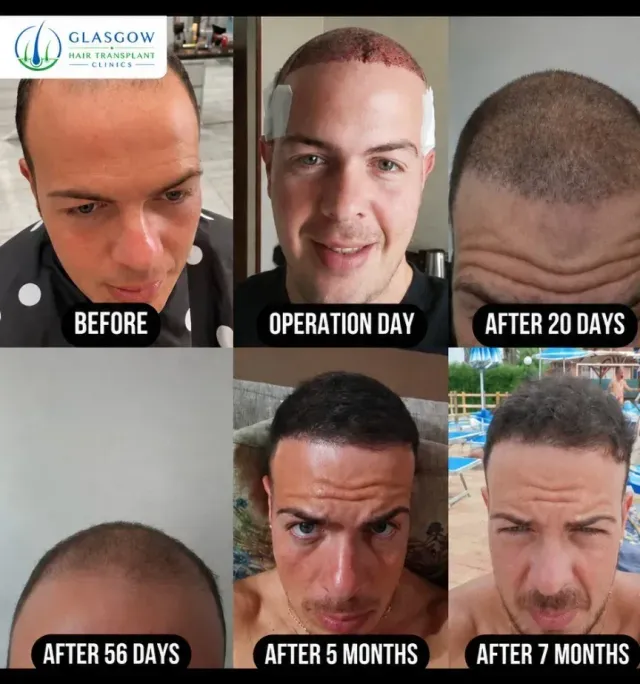
These photographs from Glasgow Hair Transplant Clinics show one patient’s hairline before surgery and during recovery. The sequence follows early healing and later growth over seven months.
Your starting density, hair characteristics and donor supply affect what can be achieved. A photograph does not tell you how many grafts your own scalp needs. At a consultation, ask to see examples involving an area and pattern similar to yours and discuss the differences.
See more Glasgow before and after results.
Looking after your hair between appointments
There is no guaranteed way to prevent inherited pattern baldness. Treatment may help preserve existing hair, but a supplement, shampoo or change in hairstyle cannot remove the inherited susceptibility. An early assessment gives you time to consider the options while there is still hair to maintain.
Look after your hair and general health
Avoid repeated pulling from tight hairstyles and limit damaging heat or chemical treatments. These steps reduce avoidable damage but do not block DHT. Eat a balanced diet and seek advice if a restrictive diet or unexplained weight change accompanies shedding. The AAD recommends supplements such as iron or zinc only when a deficiency has been identified.
Keep a useful record
Take occasional photographs of the front, temples and crown in consistent conditions. Bring a list of treatments you have tried, how long you used them and any side effects. That record can make a review more useful than relying on memory or comparing different hairstyles.
Confidence and support
Hair loss can affect confidence, relationships or how comfortable you feel in photographs. You do not have to dismiss that reaction because the condition is common. If it is affecting daily life, speak with your GP about support as well as the hair itself. The NHS includes counselling among the options for people finding hair loss difficult to cope with.
When to arrange an assessment
Arrange a medical assessment if you notice sudden or patchy loss, a painful or inflamed scalp, eyebrow or beard changes, or unexplained heavy shedding. These features can point to a condition that needs different treatment. You can also seek advice about gradual recession at any stage if it worries you.
The NHS recommends establishing the cause of hair loss before approaching a commercial hair clinic. Where the diagnosis is uncertain, your GP may investigate or refer you to dermatology. An online photograph cannot always replace examining the scalp.
For established male pattern baldness, a transplant consultation should cover future loss as well as the current bald area. Ask what happens if the hair behind a transplanted hairline continues to thin, and what options would remain if you later wanted more treatment.
How thinning can differ in women
Men commonly develop temple recession and crown loss. Women more often notice a widening parting and reduced density over the front and top, with the frontal hairline relatively preserved. There is overlap: either pattern can occasionally occur in either sex, as Alopecia UK explains.
Both can have an inherited component, but the investigation and medication choices may differ. Treatment for one person should not be shared with a partner. Women considering surgery can read our women’s hair transplant page, which explains why donor-area assessment is especially important when thinning is widespread.
Questions about treatment and regrowth
At what age does male pattern baldness start?
It can begin after puberty, including in the late teens or twenties, and becomes more common with age. The starting age does not predict an exact course. A clinician can compare the pattern, family history and rate of change before discussing treatment.
Is male pattern baldness permanent?
It is a continuing hereditary process that does not usually reverse by itself. Treatment may slow further loss and produce some regrowth, with benefits generally depending on continued use. A transplant can restore coverage in selected areas, but it does not cure the underlying tendency to thin.
Can stress alone cause hair loss in men?
Stress can trigger telogen effluvium, a separate form of shedding that may become apparent months later. It can occur alongside male pattern baldness. A sudden change should be assessed so the cause is established before you start treatment.
Does finasteride work for all types of male hair loss?
No. Finasteride is used for suitable men with androgenetic alopecia. It is not a general treatment for alopecia areata, traction damage or unexplained shedding. A prescriber should confirm the diagnosis and discuss the sexual and psychiatric side effects described above.
How long does hair-loss treatment take to work?
Medication is assessed over months. NHS guidance suggests some improvement with finasteride after three to six months; topical minoxidil may need six to twelve months to assess. After a transplant, new growth develops gradually, with the full result often taking ten to eighteen months.
Am I suitable for a hair transplant?
That requires an assessment of the cause and pattern of loss, donor hair, medical history and expectations. Having a visible bald area does not automatically mean there is enough suitable donor hair. Rapid progression or active scalp disease may mean treatment should be postponed or another approach considered.
What is the difference between FUE and DHI?
FUE describes removing follicular units individually from the donor area. DHI generally describes placing grafts with an implanter device. A procedure can involve both. Ask the surgeon to explain the harvesting and implantation plan for your scalp.
Will hair loss return after a transplant?
The surrounding, non-transplanted hair can continue to thin. Donor follicles are selected for their suitability, but the whole pattern still needs long-term planning. Medication may be discussed to help maintain existing hair where it is appropriate; it does not guarantee that further thinning will stop.
Glasgow Google reviews
Read feedback from patients of Glasgow Hair Transplant Clinics, including their experience of the team and their treatment. More feedback is available on our reviews page.

Dr Harpreet Kalra
Dr Kalra is the surgeon at Glasgow Hair Transplant Clinics, GMC reference 7126076. A consultation considers your pattern of loss, donor hair and previous treatment before discussing the options.
Bring your questions about medication, surgical methods, recovery and cost. The plan should explain what is achievable, what the risks are and how follow-up will work. If the cause needs further investigation, that should be addressed before a procedure is arranged.
Talk through the options for your hair
Arrange a consultation to discuss the changes you have noticed, what you want to achieve and which treatments may be suitable.
Book a free consultation