

Why a hairline recedes with age: causes explained
Androgenetic alopecia is the primary reason a hairline recedes with age, affecting the majority of men in the UK to a significant degree by their seventh decade. This condition is driven by a genetic sensitivity to dihydrotestosterone (DHT), a hormone that causes hair follicles to shrink progressively over time. Up to 85% of UK men are significantly affected by this type of hair loss by age 70. Understanding why this happens, and what separates normal hairline maturation from true recession, gives you the clearest path to doing something about it.


Why a hairline recedes with age: causes explained
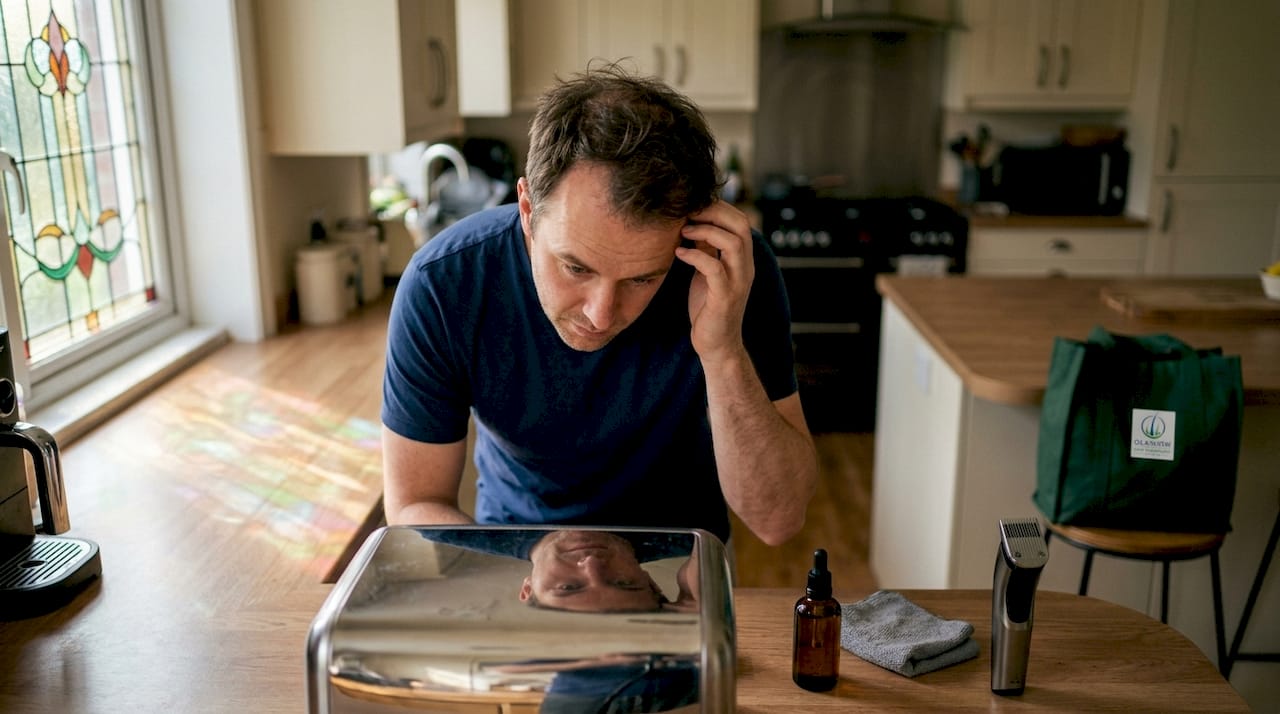
Androgenetic alopecia is the primary reason a hairline recedes with age, affecting the majority of men in the UK to a significant degree by their seventh decade. This condition is driven by a genetic sensitivity to dihydrotestosterone (DHT), a hormone that causes hair follicles to shrink progressively over time. Up to 85% of UK men are significantly affected by this type of hair loss by age 70. Understanding why this happens, and what separates normal hairline maturation from true recession, gives you the clearest path to doing something about it.
Why a hairline recedes with age: genetics and DHT
Approximately 95% of male hair loss is caused by androgenetic alopecia, driven by genetics and sensitivity to DHT. That figure tells you something important: if your hairline is changing, the cause is almost certainly biological, not a lifestyle failure.
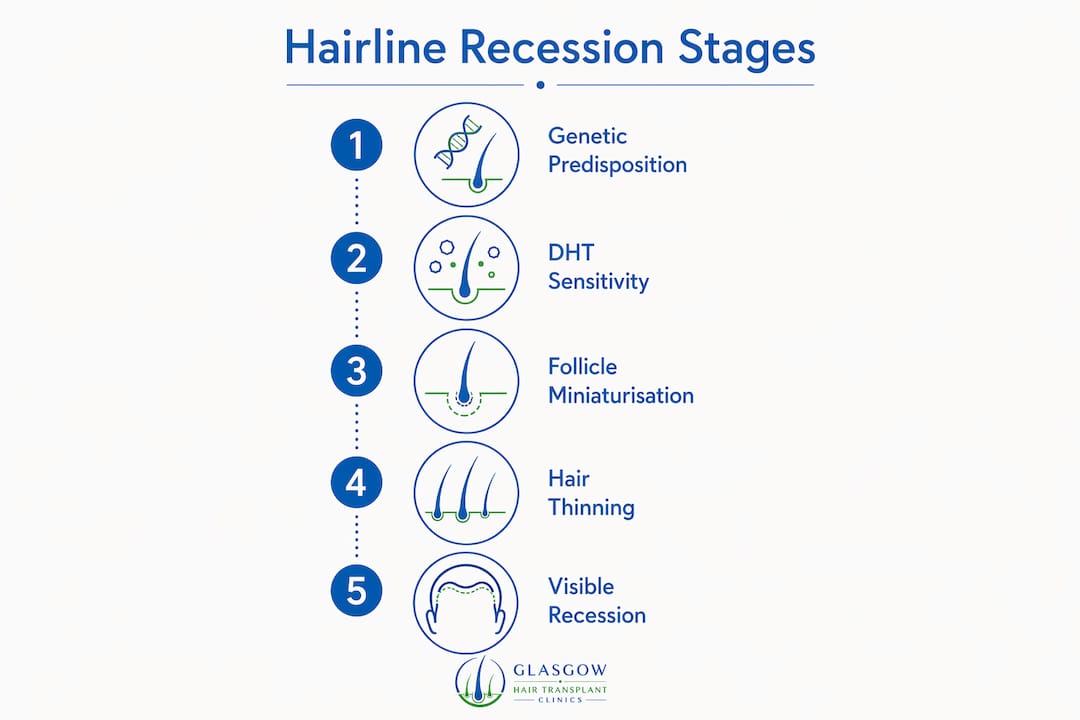
DHT is a derivative of testosterone. In men who carry the genetic predisposition, hair follicles at the temples and frontal scalp carry androgen receptors that react strongly to DHT. Each time DHT binds to these receptors, it shortens the follicle’s growth phase. Over repeated cycles, the follicle produces thinner, shorter hairs until it eventually becomes inactive. This process is called follicle miniaturisation, and it is the core mechanism behind causes of receding hairline in men over 30.
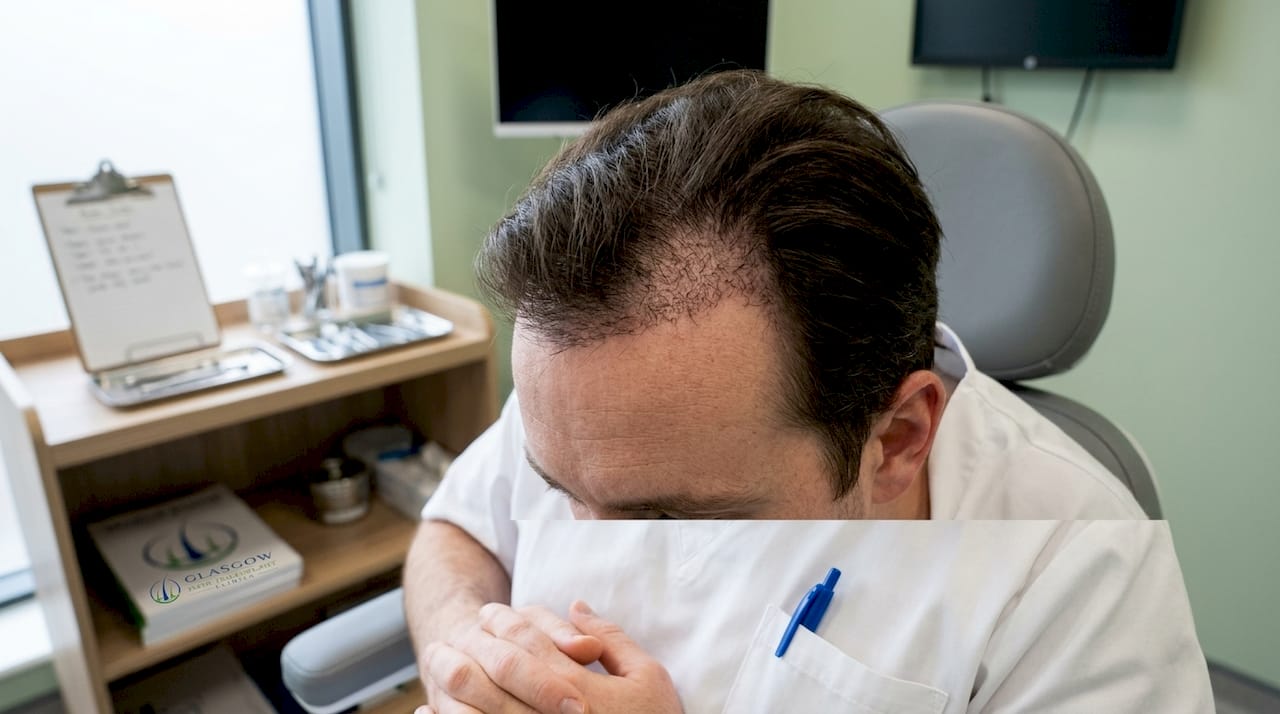
Genetic inheritance follows a complex pattern. The gene variants responsible are inherited from both parents, not just the maternal grandfather as the popular myth suggests. Onset and severity depend on which combination of variants you carry. Men who begin noticing recession in their early 30s often have a stronger genetic loading than those who first notice changes in their 50s.
Key biological facts about this process:
- Follicle sensitivity varies by location. Temple follicles have a higher concentration of androgen receptors, which is why recession begins there before spreading to the crown.
- Miniaturisation is gradual. Follicles do not switch off overnight. They produce progressively finer hairs over years before becoming dormant.
- The growth cycle shortens. A healthy follicle spends two to six years in the active growth phase (anagen). DHT-affected follicles spend weeks to months in anagen before shedding.
- Dormant follicles are not always dead. Early intervention can reactivate follicles that are miniaturised but not yet fully inactive.
Pro Tip: If you notice your temples thinning before your crown, this is consistent with androgenetic alopecia rather than a nutritional or stress-related cause. A clinical assessment will confirm the pattern and guide treatment.
Mature hairline versus receding hairline: what is the difference?
Many men in their 30s misread a receding hairline as a mature hairline, and this confusion delays treatment. A mature hairline stabilises by age 23–25, sitting slightly higher and more defined than a juvenile hairline. A receding hairline continues to move back past that age, with no natural point of stabilisation.
The shape difference is the clearest indicator. A mature hairline retains even density across the frontal band and temples. A receding hairline develops an M-shape, with the temples pulling back more rapidly than the central forelock. The density within the receding zone also changes: hairs become finer and shorter before disappearing entirely.
Slow recession in the 30s is often mistaken for maturation because the change happens over months rather than weeks. Men compare themselves to photographs from two or three years ago rather than six months ago, which makes gradual loss harder to detect. The practical consequence is that treatment begins later, when miniaturisation is more advanced.
Pro Tip: Take a standardised photograph of your hairline under consistent lighting every three months. Compare images at six-month intervals rather than relying on memory. This is the most reliable way to detect slow progression early.
Clinical observation confirms that early detection improves treatment outcomes. Follicles that are miniaturised but still producing some hair respond better to medical treatment than follicles that have been inactive for several years. The 30s represent the most critical window to intervene, because treatment in this decade can influence hair density progression over the next 20 years.
What else accelerates hairline recession beyond genetics?
Genetics remain the main driver, but modifiable factors exacerbate visible recession speed in men who are already predisposed. This distinction matters because addressing these factors will not reverse genetic hair loss, but it can meaningfully slow visible progression.
The most clinically relevant accelerants include:
- Chronic stress. Elevated cortisol disrupts the hair growth cycle by pushing follicles prematurely into the resting phase (telogen). This produces a condition called telogen effluvium, which compounds androgenetic thinning.
- Poor sleep. Growth hormone, which supports follicle activity, is released primarily during deep sleep. Consistently poor sleep reduces this output.
- Smoking. Smoking reduces blood flow to the scalp and generates oxidative stress that damages follicle cells. The effect is measurable and well-documented.
- Nutritional deficiencies. Iron and vitamin D deficiencies are the most common nutritional accelerants of hair thinning. Both are involved in follicle cell division and growth cycle regulation.
- Medical conditions. Thyroid dysfunction and scalp inflammation can cause hair loss that mimics androgenetic recession but requires entirely different treatment. A GP assessment rules these out before committing to a hair loss treatment plan.
The combined effect of these factors is significant. A man with a moderate genetic predisposition who also smokes, sleeps poorly, and has low vitamin D may experience visible recession a decade earlier than his genetics alone would predict. Addressing modifiable factors is not a substitute for medical treatment, but it is a meaningful part of managing the overall picture.
What happens to follicles as the hairline recedes?
Follicle miniaturisation is a biological process with clear stages, and understanding these stages explains why treatment timing matters so much. In the early stage, the follicle produces hairs that are slightly finer and shorter than before. In the intermediate stage, hairs become visibly thinner and the scalp begins to show through. In the advanced stage, the follicle produces only vellus hairs (the fine, colourless hairs present on most skin) or stops producing hair entirely.
Temple follicles have naturally lower density and higher androgen receptor concentration, which makes recession here more visually noticeable and biologically faster than at the crown. This is why the hairline is typically the first area to show change and the hardest to restore.
Minoxidil is generally less effective at regrowing hair at the hairline compared to the crown, because hairline follicles are more resistant once miniaturisation is advanced. This does not mean topical treatments are useless at the hairline; they can slow further loss and support follicles that are still partially active. However, the expectation of significant regrowth at the temples from minoxidil alone is not well-supported by clinical evidence.
Early and consistent treatment is vital because once hairline follicles become inactive for a prolonged period, regrowth becomes difficult to achieve through non-surgical means. Follicular Unit Extraction (FUE) hair transplantation can restore the hairline by relocating DHT-resistant follicles from the donor area at the back of the scalp. These transplanted follicles retain their original genetic resistance to DHT, which is why transplant results are long-lasting. You can review hair loss treatment options across the full spectrum, from medication to surgical restoration, to understand which stage of loss each approach addresses best.
Key takeaways
Hairline recession is driven primarily by androgenetic alopecia, and the 30s are the most important decade to act because follicle miniaturisation at the temples is progressive and increasingly difficult to reverse once advanced.
| Point | Details |
|---|---|
| Primary cause | Androgenetic alopecia, driven by DHT sensitivity and genetics, accounts for approximately 95% of male hair loss. |
| First area affected | Temple follicles have the highest androgen receptor concentration and miniaturise before the crown. |
| Mature vs. receding | A mature hairline stabilises by age 25; a receding hairline continues past that point and develops an M-shape. |
| Modifiable accelerants | Stress, poor sleep, smoking, and iron or vitamin D deficiency all speed up visible recession in predisposed men. |
| Treatment timing | Early intervention, while follicles are still partially active, produces significantly better outcomes than late-stage treatment. |
Why the 30s are the decade you cannot afford to ignore
I have spoken with many men who arrive at a consultation in their mid-40s and say the same thing: “I thought it was just my hairline maturing.” That misperception is the single most common reason treatment is delayed until miniaturisation is far advanced. The biology is clear. A mature hairline settles by the mid-20s. If your temples are still moving back at 32 or 35, that is androgenetic alopecia, not maturation.
What I find most striking is how much the 30s matter in terms of long-term outcome. Follicles that are miniaturising but still producing hair respond to medical treatment. Finasteride and minoxidil used consistently in this window can preserve density for years. Once follicles have been dormant for a prolonged period, the options narrow to surgical restoration. That is not a failure, but it is a more significant undertaking than early medical management.
Misconceptions about maturation versus recession often delay treatment until miniaturisation is too advanced to reverse fully. I would encourage anyone over 30 who notices their temples changing to seek a clinical assessment rather than waiting to see whether the change “settles.” It rarely does. A proper assessment takes the guesswork out of it and gives you a clear picture of where you are on the progression scale and what your realistic options are.
The good news is that the options available in the UK in 2026 are genuinely effective. FUE transplantation, Platelet Rich Plasma (PRP) therapy, and medical treatments used in combination produce results that were not achievable a decade ago. The key is acting while the biology is still in your favour.
— Harley
Receding hairline treatment at Glasgowhairtransplantclinics
Glasgowhairtransplantclinics offers a full range of evidence-based treatments for men experiencing hairline recession, from medical management through to surgical restoration. All surgeons are registered with the GMC, and the clinics hold CQC and HIS registration for your confidence.

Whether you are in the early stages of recession or considering a hairline hair transplant to restore a natural frontal profile, the team provides a thorough assessment before recommending any treatment. PRP therapy, FUE transplantation, and hair loss medication are all available at accessible prices across Glasgow and other UK locations. A free consultation, online or face to face, is the straightforward first step. You can also view real patient results to understand what is achievable before committing to any plan.
FAQ
What is the main reason a hairline recedes with age?
Androgenetic alopecia is the primary cause, accounting for approximately 95% of male hair loss. It is driven by a genetic sensitivity to DHT, which causes follicles at the temples to miniaturise progressively over time.
At what age does hairline recession typically begin?
Recession can begin as early as the mid-20s in men with a strong genetic predisposition, though the 30s are the most common decade for noticeable change. A mature hairline stabilises by age 23–25; any continued recession past that point indicates androgenetic alopecia.
Can a receding hairline be stopped or reversed?
Early-stage recession can be slowed significantly with consistent medical treatment, including Finasteride and minoxidil. Once follicles are fully inactive, surgical options such as FUE hair transplantation offer the most reliable route to hairline restoration.
Does stress cause a receding hairline?
Stress alone does not cause androgenetic alopecia, but chronic stress accelerates hair loss in men who are already genetically predisposed. It does this by pushing follicles into the resting phase prematurely, compounding the effects of DHT-driven miniaturisation.
How do I know if my hairline is maturing or receding?
A mature hairline stabilises by the mid-20s and retains even density. A receding hairline continues to move back past that age and develops an M-shape with thinning at the temples. Comparing standardised photographs taken every three months is the most reliable self-assessment method.
Recommended
Certifications




Why a hairline recedes with age: genetics and DHT
Approximately 95% of male hair loss is caused by androgenetic alopecia, driven by genetics and sensitivity to DHT. That figure tells you something important: if your hairline is changing, the cause is almost certainly biological, not a lifestyle failure.
DHT is a derivative of testosterone. In men who carry the genetic predisposition, hair follicles at the temples and frontal scalp carry androgen receptors that react strongly to DHT. Each time DHT binds to these receptors, it shortens the follicle’s growth phase. Over repeated cycles, the follicle produces thinner, shorter hairs until it eventually becomes inactive. This process is called follicle miniaturisation, and it is the core mechanism behind causes of receding hairline in men over 30.
Genetic inheritance follows a complex pattern. The gene variants responsible are inherited from both parents, not just the maternal grandfather as the popular myth suggests. Onset and severity depend on which combination of variants you carry. Men who begin noticing recession in their early 30s often have a stronger genetic loading than those who first notice changes in their 50s.
Key biological facts about this process:
- Follicle sensitivity varies by location. Temple follicles have a higher concentration of androgen receptors, which is why recession begins there before spreading to the crown.
- Miniaturisation is gradual. Follicles do not switch off overnight. They produce progressively finer hairs over years before becoming dormant.
- The growth cycle shortens. A healthy follicle spends two to six years in the active growth phase (anagen). DHT-affected follicles spend weeks to months in anagen before shedding.
- Dormant follicles are not always dead. Early intervention can reactivate follicles that are miniaturised but not yet fully inactive.
Pro Tip: If you notice your temples thinning before your crown, this is consistent with androgenetic alopecia rather than a nutritional or stress-related cause. A clinical assessment will confirm the pattern and guide treatment.
Mature hairline versus receding hairline: what is the difference?
Many men in their 30s misread a receding hairline as a mature hairline, and this confusion delays treatment. A mature hairline stabilises by age 23–25, sitting slightly higher and more defined than a juvenile hairline. A receding hairline continues to move back past that age, with no natural point of stabilisation.
The shape difference is the clearest indicator. A mature hairline retains even density across the frontal band and temples. A receding hairline develops an M-shape, with the temples pulling back more rapidly than the central forelock. The density within the receding zone also changes: hairs become finer and shorter before disappearing entirely.
Slow recession in the 30s is often mistaken for maturation because the change happens over months rather than weeks. Men compare themselves to photographs from two or three years ago rather than six months ago, which makes gradual loss harder to detect. The practical consequence is that treatment begins later, when miniaturisation is more advanced.
Pro Tip: Take a standardised photograph of your hairline under consistent lighting every three months. Compare images at six-month intervals rather than relying on memory. This is the most reliable way to detect slow progression early.
Clinical observation confirms that early detection improves treatment outcomes. Follicles that are miniaturised but still producing some hair respond better to medical treatment than follicles that have been inactive for several years. The 30s represent the most critical window to intervene, because treatment in this decade can influence hair density progression over the next 20 years.
What else accelerates hairline recession beyond genetics?
Genetics remain the main driver, but modifiable factors exacerbate visible recession speed in men who are already predisposed. This distinction matters because addressing these factors will not reverse genetic hair loss, but it can meaningfully slow visible progression.
The most clinically relevant accelerants include:
- Chronic stress. Elevated cortisol disrupts the hair growth cycle by pushing follicles prematurely into the resting phase (telogen). This produces a condition called telogen effluvium, which compounds androgenetic thinning.
- Poor sleep. Growth hormone, which supports follicle activity, is released primarily during deep sleep. Consistently poor sleep reduces this output.
- Smoking. Smoking reduces blood flow to the scalp and generates oxidative stress that damages follicle cells. The effect is measurable and well-documented.
- Nutritional deficiencies. Iron and vitamin D deficiencies are the most common nutritional accelerants of hair thinning. Both are involved in follicle cell division and growth cycle regulation.
- Medical conditions. Thyroid dysfunction and scalp inflammation can cause hair loss that mimics androgenetic recession but requires entirely different treatment. A GP assessment rules these out before committing to a hair loss treatment plan.
The combined effect of these factors is significant. A man with a moderate genetic predisposition who also smokes, sleeps poorly, and has low vitamin D may experience visible recession a decade earlier than his genetics alone would predict. Addressing modifiable factors is not a substitute for medical treatment, but it is a meaningful part of managing the overall picture.
What happens to follicles as the hairline recedes?
Follicle miniaturisation is a biological process with clear stages, and understanding these stages explains why treatment timing matters so much. In the early stage, the follicle produces hairs that are slightly finer and shorter than before. In the intermediate stage, hairs become visibly thinner and the scalp begins to show through. In the advanced stage, the follicle produces only vellus hairs (the fine, colourless hairs present on most skin) or stops producing hair entirely.
Temple follicles have naturally lower density and higher androgen receptor concentration, which makes recession here more visually noticeable and biologically faster than at the crown. This is why the hairline is typically the first area to show change and the hardest to restore.
Minoxidil is generally less effective at regrowing hair at the hairline compared to the crown, because hairline follicles are more resistant once miniaturisation is advanced. This does not mean topical treatments are useless at the hairline; they can slow further loss and support follicles that are still partially active. However, the expectation of significant regrowth at the temples from minoxidil alone is not well-supported by clinical evidence.
Early and consistent treatment is vital because once hairline follicles become inactive for a prolonged period, regrowth becomes difficult to achieve through non-surgical means. Follicular Unit Extraction (FUE) hair transplantation can restore the hairline by relocating DHT-resistant follicles from the donor area at the back of the scalp. These transplanted follicles retain their original genetic resistance to DHT, which is why transplant results are long-lasting. You can review hair loss treatment options across the full spectrum, from medication to surgical restoration, to understand which stage of loss each approach addresses best.
Key takeaways
Hairline recession is driven primarily by androgenetic alopecia, and the 30s are the most important decade to act because follicle miniaturisation at the temples is progressive and increasingly difficult to reverse once advanced.
| Point | Details |
|---|---|
| Primary cause | Androgenetic alopecia, driven by DHT sensitivity and genetics, accounts for approximately 95% of male hair loss. |
| First area affected | Temple follicles have the highest androgen receptor concentration and miniaturise before the crown. |
| Mature vs. receding | A mature hairline stabilises by age 25; a receding hairline continues past that point and develops an M-shape. |
| Modifiable accelerants | Stress, poor sleep, smoking, and iron or vitamin D deficiency all speed up visible recession in predisposed men. |
| Treatment timing | Early intervention, while follicles are still partially active, produces significantly better outcomes than late-stage treatment. |
Why the 30s are the decade you cannot afford to ignore
I have spoken with many men who arrive at a consultation in their mid-40s and say the same thing: “I thought it was just my hairline maturing.” That misperception is the single most common reason treatment is delayed until miniaturisation is far advanced. The biology is clear. A mature hairline settles by the mid-20s. If your temples are still moving back at 32 or 35, that is androgenetic alopecia, not maturation.
What I find most striking is how much the 30s matter in terms of long-term outcome. Follicles that are miniaturising but still producing hair respond to medical treatment. Finasteride and minoxidil used consistently in this window can preserve density for years. Once follicles have been dormant for a prolonged period, the options narrow to surgical restoration. That is not a failure, but it is a more significant undertaking than early medical management.
Misconceptions about maturation versus recession often delay treatment until miniaturisation is too advanced to reverse fully. I would encourage anyone over 30 who notices their temples changing to seek a clinical assessment rather than waiting to see whether the change “settles.” It rarely does. A proper assessment takes the guesswork out of it and gives you a clear picture of where you are on the progression scale and what your realistic options are.
The good news is that the options available in the UK in 2026 are genuinely effective. FUE transplantation, Platelet Rich Plasma (PRP) therapy, and medical treatments used in combination produce results that were not achievable a decade ago. The key is acting while the biology is still in your favour.
— Harley
Receding hairline treatment at Glasgowhairtransplantclinics
Glasgowhairtransplantclinics offers a full range of evidence-based treatments for men experiencing hairline recession, from medical management through to surgical restoration. All surgeons are registered with the GMC, and the clinics hold CQC and HIS registration for your confidence.
Whether you are in the early stages of recession or considering a hairline hair transplant to restore a natural frontal profile, the team provides a thorough assessment before recommending any treatment. PRP therapy, FUE transplantation, and hair loss medication are all available at accessible prices across Glasgow and other UK locations. A free consultation, online or face to face, is the straightforward first step. You can also view real patient results to understand what is achievable before committing to any plan.
FAQ
What is the main reason a hairline recedes with age?
Androgenetic alopecia is the primary cause, accounting for approximately 95% of male hair loss. It is driven by a genetic sensitivity to DHT, which causes follicles at the temples to miniaturise progressively over time.
At what age does hairline recession typically begin?
Recession can begin as early as the mid-20s in men with a strong genetic predisposition, though the 30s are the most common decade for noticeable change. A mature hairline stabilises by age 23–25; any continued recession past that point indicates androgenetic alopecia.
Can a receding hairline be stopped or reversed?
Early-stage recession can be slowed significantly with consistent medical treatment, including Finasteride and minoxidil. Once follicles are fully inactive, surgical options such as FUE hair transplantation offer the most reliable route to hairline restoration.
Does stress cause a receding hairline?
Stress alone does not cause androgenetic alopecia, but chronic stress accelerates hair loss in men who are already genetically predisposed. It does this by pushing follicles into the resting phase prematurely, compounding the effects of DHT-driven miniaturisation.
How do I know if my hairline is maturing or receding?
A mature hairline stabilises by the mid-20s and retains even density. A receding hairline continues to move back past that age and develops an M-shape with thinning at the temples. Comparing standardised photographs taken every three months is the most reliable self-assessment method.

About the author
Dr Harpreet Kalra is a GP and hair-transplant surgeon at Glasgow Hair Transplant Clinics. His consultations consider the diagnosis, donor area, existing hair and likely future pattern before treatment is discussed.
Have your receding hairline assessed
Our Glasgow team can assess the pattern, explain likely progression and discuss treatment options suited to your age and goals.
Book a Free Consultation