





Newcastle FUE price range: Most patients needing a moderate number of grafts budget for a mid-range price for a surgeon-led, single-day session.
Book a free consultation with Glasgowhairtransplantclinics for a personalised, itemised quote based on your donor area and hair-loss pattern.
Table of Contents
- What does a hair transplant in Newcastle cost?
- What changes the price of a hair transplant?
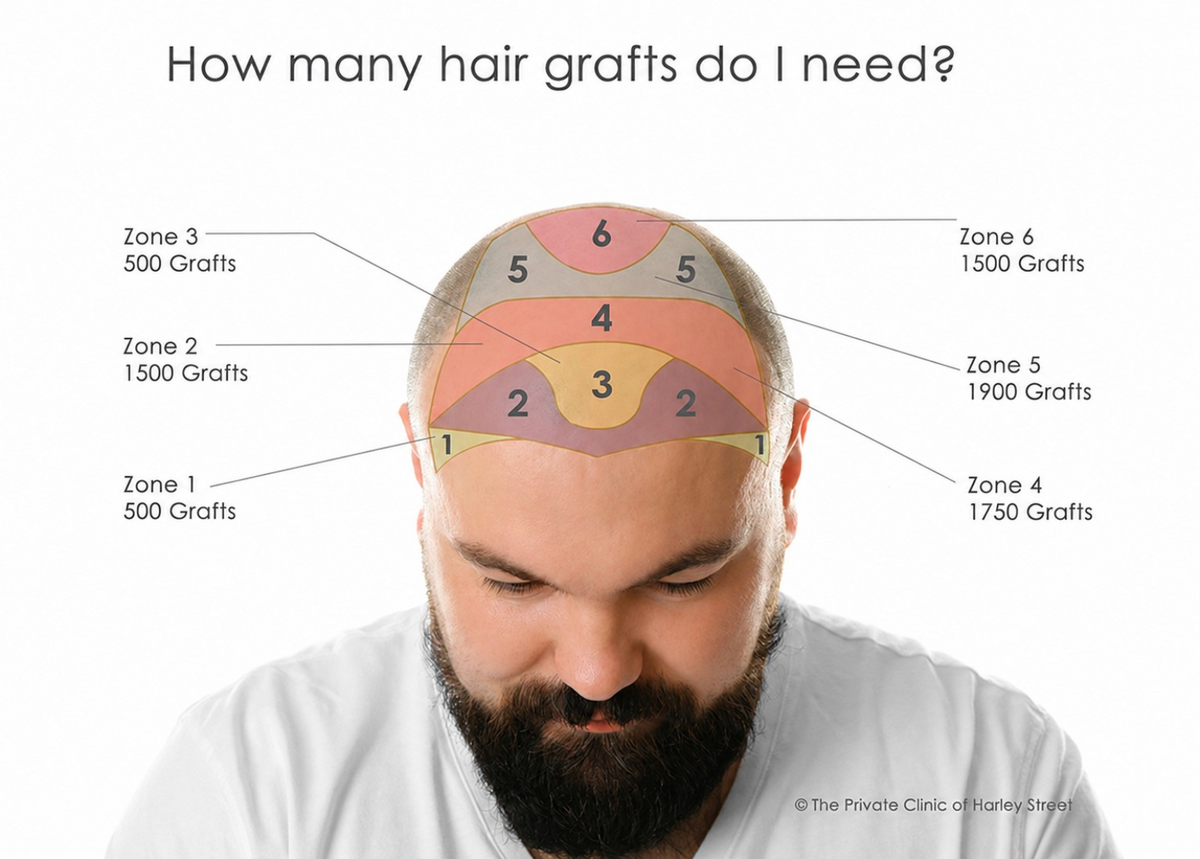
- How graft counts translate into a real Newcastle quote
- What happens at a surgeon-led consultation?
- Payment options and budgeting beyond the headline price
- How do you choose a safe Newcastle clinic?
- Why low-cost transplants carry real clinical risk
- What is the recovery timeline after a hair transplant?
- Clinic logistics for Newcastle patients
- What is the recommended next step for Newcastle patients?
- Key takeaways
- Why surgeon-led care is the only standard worth accepting
- Book a free consultation with Glasgowhairtransplantclinics
- Useful sources for verifying clinic credentials
What does a hair transplant in Newcastle cost?
UK FUE prices vary nationally, with Newcastle generally offering prices below those typically found in London. The table below maps common graft bands to realistic local price ranges and the typical patient scenario each covers.
| Graft band | Typical Newcastle FUE price | Common use case |
|---|---|---|
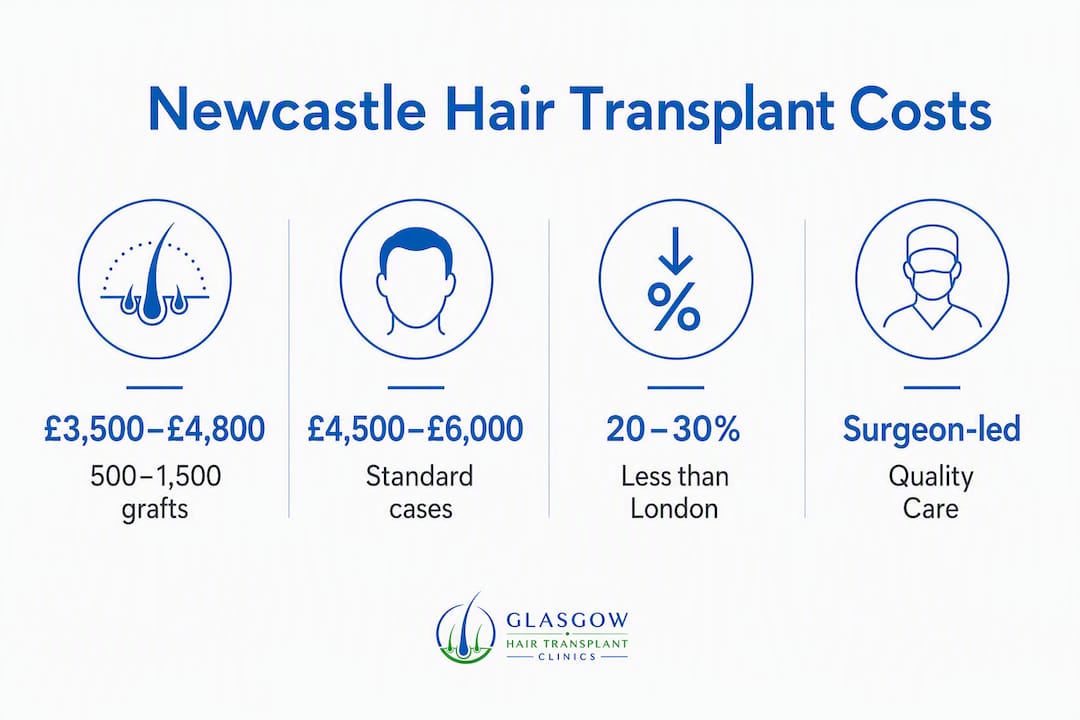
| 500–1,500 grafts | £3,500–£4,800 | Hairline refinement, temple recession |
| 1,500–2,500 grafts | £4,500–£6,000 | Moderate crown or frontal thinning |
| 2,500–3,500 grafts | £6,000–£7,500 | Combined frontal + crown, Norwood III–IV |
| 3,500+ grafts | £8,000–£10,000+ | Extensive loss, Norwood V–VI, staged cases |
These figures reflect surgeon-led FUE in a CQC-registered setting. They are not the cheapest quotes you will find online, and that gap is worth understanding before you book.
What the headline price usually covers
Most reputable Newcastle clinics include theatre time, the surgical procedure itself, and a basic post-operative care kit in the quoted figure. What is often excluded:
- Pre-operative blood tests and medical clearance
- Prescription medications (finasteride, minoxidil, antibiotics)
- PRP (Platelet Rich Plasma) therapy as an add-on
- Follow-up review appointments beyond the first post-op check
- Hair wash and nurse aftercare sessions
The NHS advises patients to request itemised quotes because many clinics bundle or exclude PRP, medications, and follow-ups from their advertised prices. A headline figure of £4,500 can become £5,500–£6,000 once those extras are added. Always ask for a written breakdown before comparing clinics.
What changes the price of a hair transplant?
Several variables shift the cost of a procedure significantly, and not all of them are obvious from a clinic’s website.
Clinical cost drivers
- Graft count: The single biggest variable. More grafts mean longer theatre time, more consumables, and greater surgeon workload.
- Technique: Standard FUE is the most common. DHI (Direct Hair Implantation using a Choi implanter pen) typically adds £500–£2,000 to the total because of longer chair time and specialised equipment. FUT (strip) is less common but can be lower cost per graft for very large cases.
- Surgeon involvement: A fully surgeon-led procedure, where the same GMC-registered doctor performs extraction, site creation, and implantation, costs more than a model where a technician team handles most steps. That difference is not cosmetic; it directly affects outcomes.
- Donor complexity: Scarred scalps, previously harvested donor areas, or low-density donors require more time and skill, which adds cost.
Non-clinical cost drivers
- Clinic location and overheads: — Newcastle clinics generally carry lower overheads than London practices. Regional clinics in the North of England are often 20–30% lower in cost than comparable London providers for the same graft count and surgical standard.
Pro Tip: Ask the clinic to break out surgeon time from technician time on the quote. If the quote does not name the surgeon or specify who performs each step, that is a significant red flag.
How graft counts translate into a real Newcastle quote
UK clinics typically charge £3.00–£5.00 per graft for surgery only, though many also offer fixed-package pricing. The examples below use that range alongside a realistic Newcastle package model to give you a working budget.
-
1,000–1,500 grafts (hairline and temples): At £3.50–£4.50 per graft, surgery-only cost runs £3,500–£6,750. A fixed Newcastle package for this range typically falls between £3,500 and £4,800. Suitable for early-stage recession or a defined hairline refinement. Surgeon involvement and PRP are usually not included at the lower end.
-
2,000–2,500 grafts (frontal zone or moderate crown): The most common case size. A typical Newcastle package lands at £4,500–£6,000. At a per-graft rate of £3.50–£4.50, the surgery-only calculation gives £7,000–£11,250, which is why fixed packages often represent better value at this volume. Confirm whether PRP and a follow-up review are included.
-
3,000 grafts (combined frontal and crown, Norwood III–IV): This is the most-searched graft count in the UK. At £3.00–£5.00 per graft, the surgery-only range is £9,000–£15,000, but fixed Newcastle packages for 3,000 grafts from a CQC-registered, surgeon-led clinic typically run £6,000–£7,500. The gap between per-graft and package pricing is largest here, so always ask which model the clinic uses.
-
4,000+ grafts (extensive loss, Norwood V–VI): Cases of this size often require a staged approach across two sessions. Budget £8,000–£10,000+ for a single large session, or plan for two separate procedures. Donor-area assessment is critical at this volume; a thorough consultation will determine whether a single session is clinically appropriate.
How much do 3,000 grafts cost in Newcastle? A surgeon-led, CQC-registered Newcastle clinic typically provides fixed-package quotes for 3,000-graft FUE sessions, with prices varying based on clinic policies and included services. Per-graft pricing at £3.00–£5.00 per graft produces a wider range; always confirm which model applies and what is included.
What happens at a surgeon-led consultation?
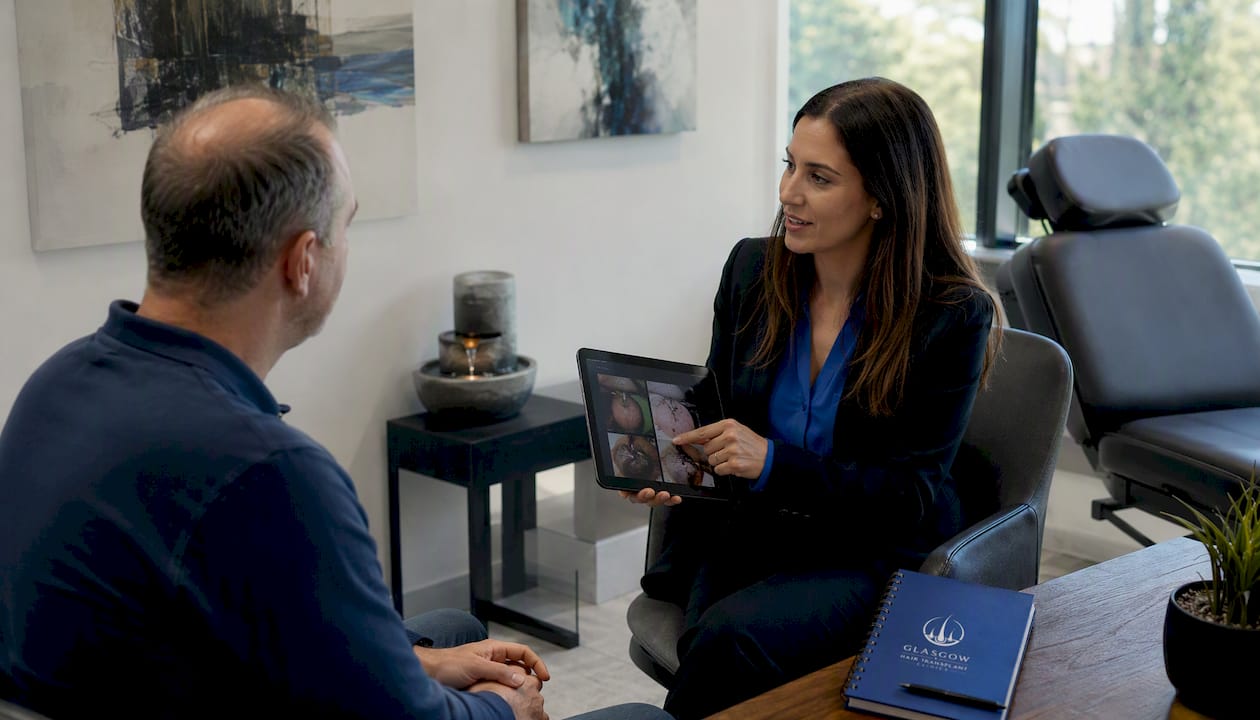
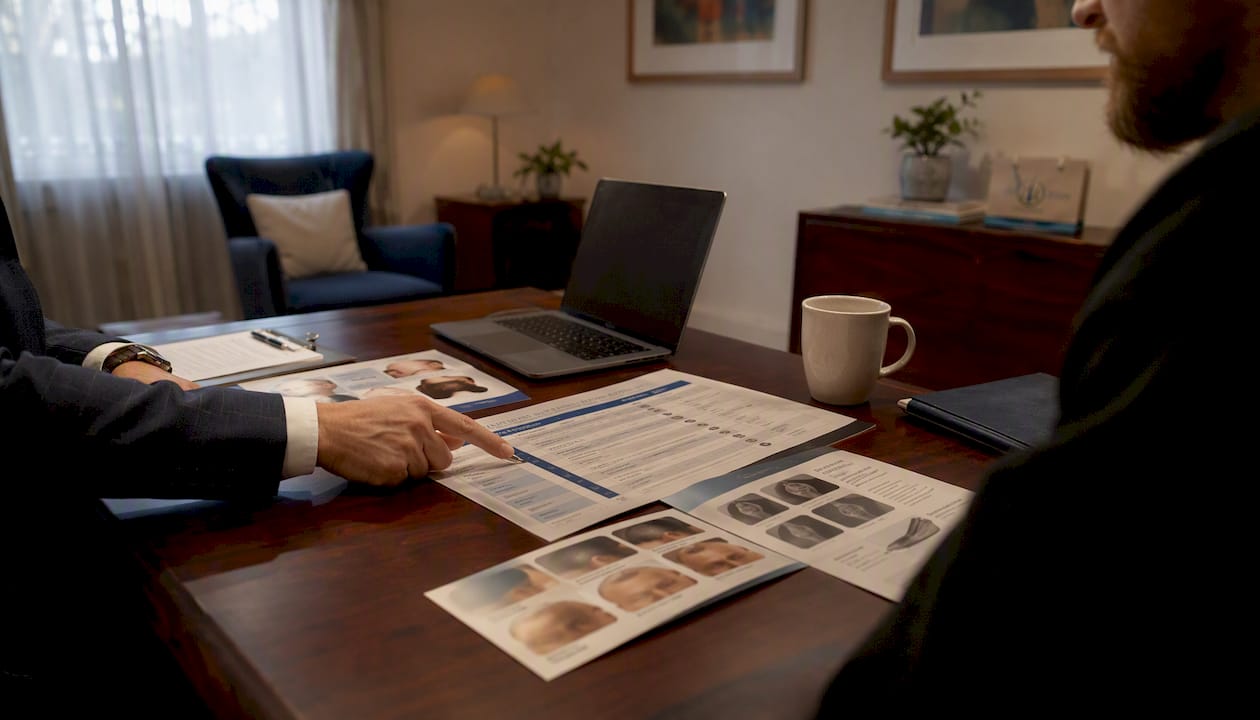
A thorough consultation is where your personalised quote is built. It is not a sales meeting; it is a clinical assessment, and the quality of that assessment determines the accuracy of everything that follows. The role of consultation in hair transplant surgery covers this in detail, but the core steps are:
- Medical history review: Current medications, previous scalp procedures, family history of hair loss, and any conditions affecting healing or donor viability.
- Donor area assessment: The surgeon examines density, hair calibre, and available safe donor zone. This determines the maximum number of grafts that can be harvested without compromising the donor area long-term. See the hair transplant donor area guide for what this involves.
- Hair density measurements: Trichoscopy or manual density counts establish the recipient area’s current state and how many grafts are needed for a natural result.
- Norwood staging: Classifying your hair-loss pattern helps the surgeon plan a hairline that will still look natural as loss progresses.
- Photo plan and graft estimate: The surgeon produces a written graft estimate and, in many cases, a photographic treatment plan showing proposed hairline design.
Questions to ask at your consultation
Bring these to every consultation, regardless of which clinic you visit:
- Who performs each step: extraction, site creation, and implantation? Is it the named surgeon throughout?
- What is the surgeon’s GMC registration number, and can you verify it before the appointment?
- What is included in the quoted price, and what will be charged separately?
- What aftercare is provided, and for how long?
- What is the policy if you need a revision or if graft yield is lower than estimated?
- What is the deposit and cancellation policy?
Pro Tip: Use the hair loss consultation preparation guide to prepare a written list of questions and bring photographs of your hair loss progression. Clinics that welcome prepared patients are generally more transparent.
Payment options and budgeting beyond the headline price
Most reputable UK hair transplant clinics offer several payment models, and understanding them helps you compare quotes accurately.
Common payment structures
- Full payment upfront: Some clinics offer a small discount for full payment at booking. Confirm the refund policy before committing.
- Deposit plus balance: A deposit (typically £200–£500) secures the date, with the balance due on the day of surgery or shortly before.
- Third-party finance: Many clinics partner with regulated finance providers to offer monthly payment plans. Interest-free options are sometimes available for shorter terms; longer terms may carry interest. Confirm the APR and total repayable amount before signing.
- Monthly instalment plans: Offered directly by some clinics, though these are less common than third-party finance arrangements.
Typical extras to budget for
Itemised quotes are strongly recommended because the gap between a headline price and the true cost of a procedure can be meaningful. Common additions include:
- Pre-operative blood tests: £100–£250
- Medication pack (antibiotics, anti-inflammatories, minoxidil): £50–£150
- PRP therapy as an add-on: £300–£600 per session
- Additional follow-up reviews beyond the first post-op check
- Hair wash and nurse aftercare sessions in the first week
Pro Tip: Request a written, itemised quote that specifies the graft cap (the maximum number of grafts covered at the quoted price), whether VAT applies to any line item, and the exact window for included follow-up reviews. A clinic that provides this without hesitation is demonstrating the kind of transparency that correlates with good clinical practice.
For a detailed breakdown of what often gets left out of headline prices, the hidden costs of a hair transplant guide is worth reading before your consultation.
How do you choose a safe Newcastle clinic?
Price is a reasonable starting point, but it should not be the deciding factor. The clinics that produce the best long-term results are those that prioritise clinical standards over volume. Here is what to look for, and what to avoid.
Trust signals to verify
- CQC registration: The Care Quality Commission regulates health and social care services in England. Any clinic performing surgical hair transplants must be registered. Search the CQC website by clinic name or address before booking.
- Named surgeon with a GMC number: The General Medical Council maintains the register of licensed doctors in the UK. Every surgeon performing incisions in donor and recipient sites must be on this register. Search by name at gmc-uk.org.
- BAHRS or ISHRS membership: The British Association of Hair Restoration Surgery (BAHRS) and the International Society of Hair Restoration Surgery (ISHRS) set professional standards for the specialty. Membership is not mandatory, but it signals a commitment to peer-reviewed practice.
- Before and after gallery with timelines: Real patient results photographed at consistent intervals (3, 6, and 12 months post-op) are far more informative than a handful of curated images. View the before and after gallery as a reference for what credible results documentation looks like.
- Clear, itemised pricing and a published aftercare policy: Transparency in pricing and aftercare is a strong proxy for good clinical governance.
- Surgeon-performed vs technician-led disclosure: Ask directly. A clinic that is open about its staffing model is more trustworthy than one that deflects the question.
Red flags to watch for
- Flat quotes with no clinical assessment or graft estimate attached
- No named surgeon, or a surgeon whose GMC number cannot be verified
- Language suggesting a production-line model (“unlimited grafts,” “all-inclusive packages” with no clinical basis)
- Pressure to pay a deposit immediately, with no cooling-off period
- Claims of “scarless” results or guaranteed outcomes. Professional standards guidance explicitly warns against misleading claims and guaranteed outcomes in hair transplant advertising.
- Strong encouragement to travel overseas for a lower price, particularly when the clinic cannot provide CQC or equivalent regulatory documentation
For a structured approach to checking credentials before you commit, the due diligence guide covers the verification steps in full.
Why low-cost transplants carry real clinical risk
The appeal of a significantly lower price is understandable, but the risks attached to under-regulated, technician-led models are well-documented within the profession.
BAHRS guidance on surgeon involvement is clear: hairline design, graft placement, and preservation of the donor area are the critical determinants of long-term outcome, and those skills are surgeon-dependent. A model where a technician team performs extraction and implantation without direct surgeon oversight increases the risk of poor graft survival, unnatural hairline design, and donor-area depletion that cannot be corrected.
“Patients should be aware that the skill of the surgeon in hairline design and graft placement is more important than the number of grafts transplanted. Choosing a provider based on price alone, without verifying surgeon involvement and regulatory compliance, significantly increases the risk of a poor outcome.” — BAHRS patient guidance on regulation
Under UK practice standards, surgical steps that create incisions in donor and recipient sites must be undertaken within regulated settings by a GMC-registered doctor. A clinic that cannot confirm CQC registration and a named, GMC-registered surgeon is not meeting those standards, regardless of how professional its website appears.
Consider the downstream cost of a failed procedure. Corrective work on a poorly executed transplant is technically demanding, more expensive than the original procedure, and not always fully achievable. The initial saving on a low-cost model can be substantially outweighed by the cost of revision surgery.
Pro Tip: To verify a surgeon’s GMC registration, go to gmc-uk.org, select “Check a doctor’s registration,” and enter the surgeon’s full name. The result shows their registration status, licence to practise, and any fitness-to-practise history. Do this before your consultation, not after.
What is the recovery timeline after a hair transplant?
Setting realistic expectations before surgery makes the recovery period considerably less stressful. Recovery milestones are well-established and follow a predictable pattern for most patients.
- Days 0–14: The scalp is tender and swollen in the first 48–72 hours. Scabs form around the transplanted grafts and shed naturally over 10–14 days. Avoid touching, scratching, or exposing the scalp to direct sunlight. Sleep with your head elevated for the first few nights to reduce swelling.
- Weeks 4–12: Shock loss is normal and expected. The transplanted hairs shed before the follicles enter a new growth cycle. This phase alarms many patients, but it is a standard part of the process. The follicles remain intact beneath the scalp. See the hair transplant shedding guide for a full explanation of what is happening and what is not a cause for concern.
- Months 6–12: Meaningful regrowth begins around month 3–4, with visible density improvements from month 6 onwards. Final results, including full density and natural texture, are typically visible at 12 months. Some patients, particularly those with finer hair, see continued improvement up to 18 months.
- When to consider a review: If density at 12 months is below expectation, a review with your surgeon is appropriate. A second session may be recommended, or PRP therapy may be suggested to support ongoing density.
Pro Tip: Post-operative PRP therapy and clinician-recommended medications such as minoxidil can support graft survival and reduce the severity of shock loss. Ask your surgeon at consultation whether these are recommended for your case, and factor the cost into your overall budget.
Clinic logistics for Newcastle patients
Newcastle is well-served by transport links, which makes attending a clinic in the city or travelling to a nearby regional clinic straightforward for most patients.
Appointment length and session planning
- A standard FUE session of 1,500–2,500 grafts typically takes 6–8 hours, including preparation, anaesthesia, extraction, and implantation.
- Larger cases of 3,500+ grafts may run 8–10 hours or be split across two days. Confirm this with your clinic at consultation; some prefer staged sessions to protect donor-area integrity.
- Plan to arrive early and arrange a companion or taxi for the return journey. Driving immediately after surgery is not advisable.
Travel and recovery logistics
- Newcastle Central station provides direct rail links to Glasgow, Edinburgh, Leeds, and London, making it accessible for patients travelling from across the North of England and Scotland.
- An overnight stay is rarely necessary for a standard single-day FUE session, but patients travelling from further afield for large cases may prefer to book local accommodation.
- Parking is available near most Newcastle clinic locations; confirm this when booking.
- Arrange at least 5–7 days away from physically demanding work or environments with dust and direct sun exposure.
Newcastle vs London pricing
Regional clinics in the North of England, including Newcastle, typically charge 20–30% less than comparable London providers for the same surgical standard and graft count. That saving is real and legitimate; it reflects lower clinic overheads rather than a reduction in surgical quality. The key is to verify that the Newcastle clinic meets the same regulatory standards (CQC, GMC, BAHRS/ISHRS) as its London counterparts before assuming equivalence.
What is the recommended next step for Newcastle patients?
The clearest path to a safe, accurate quote is a surgeon-led consultation at a CQC-registered clinic where the operating surgeon holds a current GMC registration. No online price guide, including this one, can substitute for a clinical assessment of your donor area, hair-loss pattern, and medical history.
When you attend your consultation, bring:
- Photographs documenting your hair loss progression over the past 2–3 years
- A list of current medications and any relevant medical history
- Your written list of questions (who performs each step, what is included, what the aftercare policy covers)
- A note of the clinic’s CQC registration number and the surgeon’s GMC number, verified in advance
Regulated clinics will provide a written, itemised quote following the consultation, with no pressure to commit on the day. A cooling-off period before any deposit is taken is standard practice in reputable settings. If a clinic pushes for an immediate decision or deposit without a written quote, walk away.
Glasgowhairtransplantclinics offers free online and face-to-face consultations for Newcastle patients, with GMC-registered surgeons and CQC-registered clinic settings. Request a quote to arrange your assessment and receive a personalised, itemised treatment plan.
It is not a substitute for professional medical advice. Confirm current pricing, eligibility, and clinical suitability with a qualified surgeon before making any treatment decision.
Key takeaways
A surgeon-led FUE hair transplant in Newcastle for a standard moderate graft case typically falls within a mid-range budget, and verifying CQC registration and the surgeon’s GMC number before paying any deposit is the single most important protective step a patient can take.
| Point | Details |
|---|---|
| Newcastle FUE price range | Most standard cases cost £4,500–£6,000; larger sessions (3,000+ grafts) run £6,000–£7,500+. |
| Get a graft estimate first | No quote is meaningful without a clinical donor assessment; always request a written graft count. |
| Verify CQC and GMC | Check the clinic’s CQC registration and the surgeon’s GMC number before paying any deposit. |
| Request an itemised quote | Pre-op tests, PRP, medications, and follow-ups are often excluded from headline prices. |
| Glasgowhairtransplantclinics | Offers free consultations for Newcastle patients with CQC-registered clinics and GMC-registered surgeons. |
Why surgeon-led care is the only standard worth accepting
There is a version of this conversation that focuses entirely on finding the lowest price, and it is the wrong conversation to be having. The hair transplant market in the UK has a transparency problem: headline prices vary by thousands of pounds for ostensibly similar procedures, and the difference is rarely explained clearly to patients before they book.
What actually determines the quality of your result is not the price on the website. It is whether a qualified, GMC-registered surgeon designs your hairline, performs the extraction, and places the grafts. Those are not interchangeable steps. A technician-led model may cost less, but the risk of poor graft survival, an unnatural hairline, or donor-area damage that cannot be reversed is meaningfully higher. Corrective surgery is expensive, technically demanding, and not always fully achievable.
The regional pricing advantage in Newcastle is real. Patients can access surgical standards comparable to London at a genuinely lower cost, and that is worth knowing. But the due diligence requirements are identical regardless of price point. CQC registration, a named GMC-registered surgeon, BAHRS or ISHRS membership, and a willingness to provide an itemised quote are not premium extras. They are the baseline.
The patients who get the best long-term results are those who ask the right questions before they book, not those who found the cheapest quote.
Book a free consultation with Glasgowhairtransplantclinics
Glasgowhairtransplantclinics provides surgeon-led hair restoration for Newcastle patients at CQC-registered, CQC-registered clinics, with every operating surgeon on the GMC register. The difference from a volume-led model is straightforward: your consultation, your treatment plan, and your procedure are all overseen by a qualified surgeon, not delegated to a technician team.
Services available to Newcastle patients include FUE hair transplants, DHI procedures, beard transplants, eyebrow transplants, PRP therapy, and Scalp Micro Pigmentation (SMP). Every patient receives a free online or face-to-face consultation that includes a donor area assessment, a personalised graft estimate, and a written, itemised quote with no obligation to proceed.
To book your free consultation and receive a Newcastle-area quote, visit the clinic locations page or request a quote directly. Bring your questions; the consultation is the right place to ask all of them.
Useful sources for verifying clinic credentials
The sources below are the official verification points every Newcastle patient should use before booking.
- NHS patient information on hair transplants: — Provides independent guidance on what to expect, questions to ask, and the risks involved. A useful benchmark for what a reputable clinic should be telling you.
| Source | What it verifies | How to use it |
|---|---|---|
| GMC register | Surgeon’s licence to practise | Search by full name at gmc-uk.org before your consultation |
| CQC register | Clinic’s regulatory registration | Search by clinic name or postcode; check inspection rating |
| BAHRS directory | Surgeon’s specialist membership | Confirm membership and read patient regulation guidance |
| NHS patient info | Independent procedure guidance | Use as a benchmark for what clinics should be telling you |
| BAPRAS guides | Recovery and surgical standards | Review expected milestones and post-op care standards |

About the author
Dr Harpreet Kalra is a GP and hair-transplant surgeon at Glasgow Hair Transplant Clinics. His consultations consider the diagnosis, donor area, existing hair and likely future pattern before treatment is discussed.
Compare your hair transplant options with our Glasgow team
We provide a clear, itemised quote after reviewing your donor area, hair-loss pattern and treatment goals.
Book a Free Consultation