




FUE vs FUT: what UK patients need to know

Dr Harpreet Kalra • August 3, 2026

FUE vs FUT: what UK patients need to know

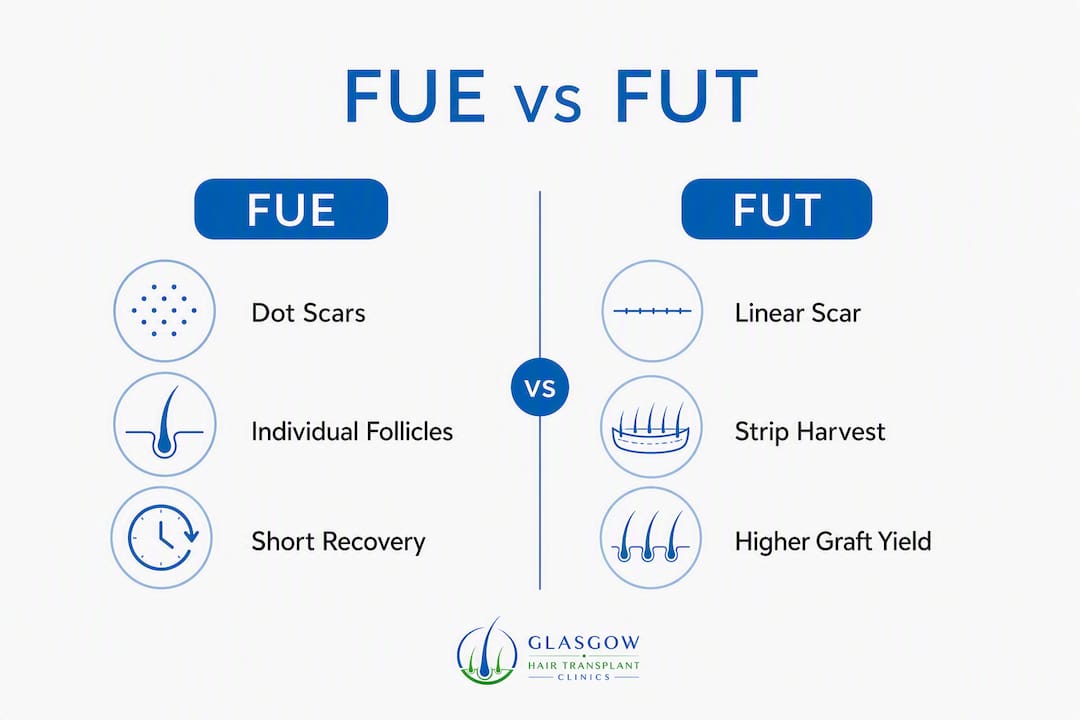
For most UK patients, FUE (Follicular Unit Extraction) is the better default choice. It leaves no linear scar, suits shorter hairstyles, and typically offers a faster recovery than FUT (Follicular Unit Transplantation, also called the strip method). That said, ISHRS guidance is clear: the FUE vs FUT decision is best framed as a donor-management question, not a simple ranking of one technique over the other.

The three factors that most often determine which method suits you:

  • Donor-area management. FUE extracts individual follicular units across a wider surface area; FUT removes a strip from the central safe donor zone, concentrating the harvest where DHT-resistant follicles are most reliable.
  • Single-session graft ceiling. FUT can yield a higher graft count in one session for patients with significant hair loss; FUE is well suited to smaller or staged procedures.
  • Hairstyle preferences. FUE suits patients who wear their hair short or buzzed; FUT is a reasonable option for those who keep longer hair that conceals a linear scar.

Before committing to either technique, a thorough donor-area assessment with a qualified surgeon is the single most valuable step you can take. Glasgowhairtransplantclinics offers free consultations, online or face-to-face, at clinics in Glasgow, Newcastle, and other UK locations.


Table of Contents

What are FUE and FUT, and how does each harvest donor hair?

Both techniques move hair from a donor zone (usually the back and sides of the scalp) to areas of thinning or loss. The fundamental difference is how that donor hair is removed.

Follicular Unit Extraction (FUE)

  1. The donor area is shaved or trimmed short.
  2. A small circular punch (typically 0.6–1.0 mm in diameter) is used to score around individual follicular units one by one.
  3. Each unit is extracted directly from the scalp, leaving a tiny round wound that heals as a small dot scar.
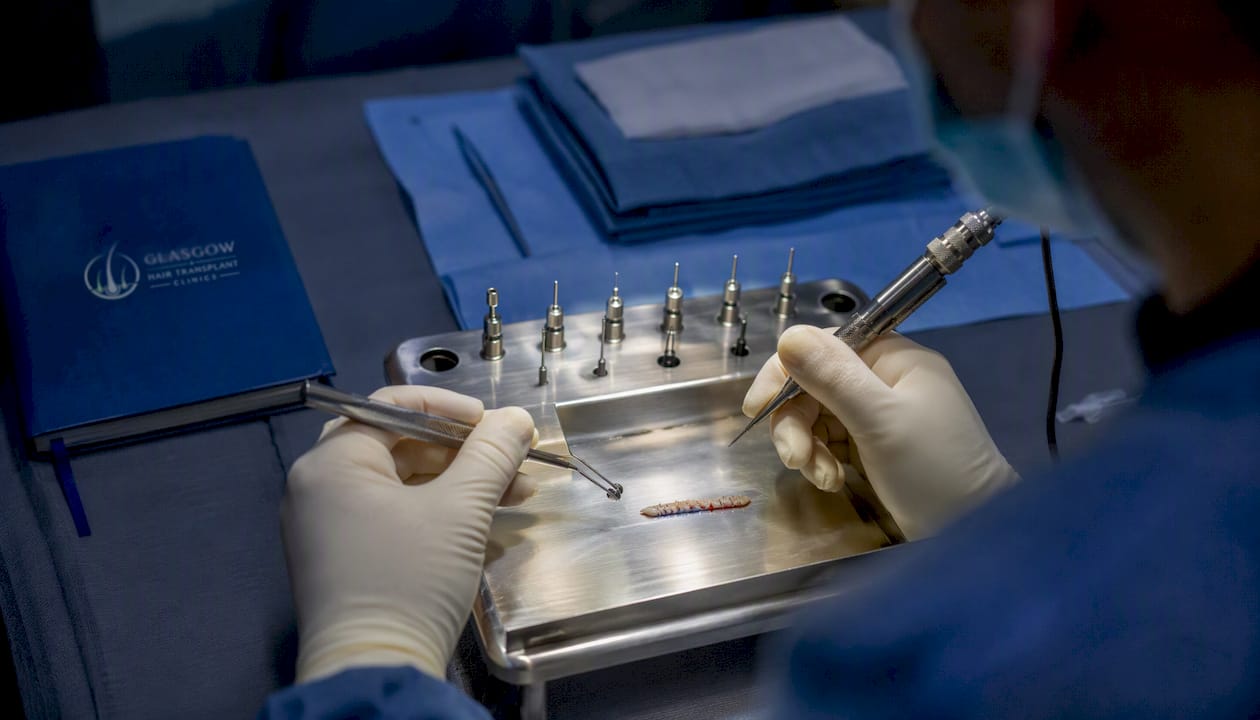
  4. Extracted grafts are prepared under magnification and stored in a holding solution.
  5. Recipient sites are made in the thinning area, and grafts are placed individually.

The result in the donor zone is a scatter of small dot scars. With sufficient hair density, these are invisible at most hair lengths, though they can become noticeable if the head is shaved very close.

Follicular Unit Transplantation (FUT, or strip method)

  1. A strip of scalp skin is surgically removed from the back of the head, typically under local anaesthetic.
  2. The wound is closed with sutures or staples, leaving a single linear scar.
  3. The strip is dissected under microscopes by a team of technicians into individual follicular units of 1–4 hairs, as described by the NHS.
  4. Recipient sites are created and grafts are implanted in the same way as FUE.

FUT does not require the donor area to be shaved, which some patients prefer. The linear scar sits low on the back of the head and is generally hidden by hair of a moderate length.


How do FUE and FUT compare across the dimensions that matter?

Multiple peer-reviewed reviews conclude that when graft counts and surgical quality are equivalent, cosmetic outcomes in the recipient area are broadly comparable between the two techniques. The meaningful differences lie in the donor area and the patient experience around the procedure.

Dimension FUE FUT (Strip)
Scarring Multiple small dot scars scattered across donor zone Single linear scar at the back of the head
Single-session graft capacity Moderate; limited by safe extraction ceiling per area Higher; concentrates harvest in the central safe donor zone
Graft quality / survival Excellent with skilled teams; some studies note a 3–8% lower survival rate vs FUT Slightly higher survival in some series; dissection under magnification preserves graft integrity
Recovery time Typically faster; most patients return to desk work within a few days Longer donor-site healing; sutures removed at 7–14 days; scalp tightness common
Pain and anaesthesia Local anaesthetic; minimal post-operative donor discomfort Local anaesthetic; donor site can feel tight or tender during healing
Hairstyle suitability Suits short, buzzed, or shaved styles Better suited to longer hair that conceals the linear scar
Cost shape Generally higher per graft due to time-intensive extraction Often lower per graft; session pricing varies by clinic
Risk profile Transection risk; donor thinning if over-extracted Linear scar widening; scalp tension; wound dehiscence (rare)
Impact on future options Preserves strip option for later; but large-area extraction can thin donor zone Limits strip width for future sessions; FUE can be added later

A few summary points worth noting:

  • Scarring: Neither scar type is universally better. Dot scars are preferable for short hairstyles; a linear scar is less noticeable under longer hair.
  • Graft survival: Clinical reports cite a 3–8% survival advantage for FUT in some series, although experienced FUE teams narrow this gap considerably.
  • Recovery: FUE generally offers a faster return to normal activity, with less donor-site restriction.
  • Final choice: Donor density, hair texture, and the patient’s long-term loss pattern are the decisive variables, not technique preference alone.


How does each method affect your donor area and future procedures?

The donor zone is a finite resource. How it is managed across a patient’s lifetime determines whether future sessions remain possible and whether results look natural decades later.

FUE extracts follicular units individually across a wider surface area. Practitioners advise limiting extraction to a safe proportion of any given area to avoid visible thinning, a phenomenon sometimes described as a “moth-eaten” appearance. Because FUE needs approximately five times the surface area of FUT to reach the same graft count, there is a real risk of encroaching on follicles outside the central DHT-resistant safe zone, particularly in patients with lower donor density.

FUT concentrates the harvest within the safe donor zone by removing a strip from its centre. This means the follicles used are almost exclusively those least likely to be lost to future androgenetic alopecia. The trade-off is a permanent linear scar.

Scar concealment at a glance:

  • FUE dot scars: generally invisible at hair lengths of 1 cm or more; can show at grade 1–2 clipper settings.
  • FUT linear scar: typically hidden by hair of 2–3 cm length at the back; may require longer coverage for wider scars.
  • Gender considerations: women rarely need to shave the donor area for FUE and often have sufficient length to conceal either scar type; men who prefer very short back-and-sides should lean towards FUE.

Donor planning is not just about the current procedure. A patient in their late twenties with Norwood grade 3 loss may need two or three sessions over their lifetime. Treating the first procedure as the only procedure is one of the most common planning errors in hair restoration surgery.

Pro Tip: Ask your surgeon to map your donor zone before any procedure and discuss the total estimated graft requirement for your projected long-term loss pattern, not just the grafts needed today. This single conversation can prevent donor depletion later.

For a detailed guide to donor-area planning, Glasgowhairtransplantclinics has a dedicated hair transplant donor area guide that covers mapping, safe extraction limits, and scar concealment.


What happens on the day, and what does recovery look like?

On the day

Both procedures are performed under local anaesthetic as day cases. FUE for a moderate graft count (1,500–2,500 grafts) typically takes six to eight hours; FUT for an equivalent count can be somewhat shorter because strip dissection by a skilled team is efficient. Most clinics use a surgeon for extraction and a trained technician team for graft preparation and implantation.

Recovery timeline

  1. First 48 hours. Mild swelling around the forehead and donor area; small scabs form at recipient sites. Sleep with the head elevated. Avoid touching or wetting the grafts.
  2. Days 7–14. Scabs begin to shed naturally. FUT patients return for suture removal. Donor-area tightness from FUT is common during this period.
  3. Weeks 3–6. Transplanted hairs shed (shock loss); this is normal and expected. The scalp looks sparse before regrowth begins.
  4. Months 4–12. New hair growth becomes visible from around month four; full density and texture typically mature at 12 months, sometimes up to 18 months.

Aftercare checklist

  • Avoid strenuous exercise for at least two weeks post-procedure.
  • Keep the scalp out of direct sunlight for the first month.
  • Follow the clinic’s prescribed washing routine from day three or four onwards.
  • Avoid alcohol and smoking in the days before and after surgery, as both impair healing.
  • Attend all follow-up appointments; photograph progress at regular intervals.

Glasgowhairtransplantclinics provides a written aftercare plan with every procedure. The before and after hair transplant guide covers the full preparation and recovery checklist in detail.

Risks and complications

Common short-term (both techniques):

  • Scabbing and temporary redness at recipient and donor sites.
  • Mild infection (rare with proper aftercare).
  • Temporary shock loss of existing hair near recipient sites.

FUE-specific:

  • Follicle transection during extraction, particularly with less experienced operators. Literature warns of a steep learning curve and higher transection risk in high-volume FUE performed by inexperienced providers.
  • Donor-area thinning or a moth-eaten appearance if extraction limits are exceeded.

FUT-specific:

  • Linear scar widening, particularly in patients with poor scalp laxity.
  • Prolonged scalp tightness or numbness along the scar line.
  • Wound dehiscence (rare).


How does UK pricing work, and what should you expect from quotes?

UK hair transplant pricing follows two broad models: a per-graft rate or an all-inclusive session/package fee. FUE typically costs more than FUT on a per-graft basis because individual extraction is more time-intensive. The total cost of any procedure depends on graft count, clinic location, surgeon experience, and what is included in the quote.

Rather than stating specific figures that vary widely by case and clinic, the more useful exercise is understanding what a quote should contain and what questions to ask. For current pricing at Glasgowhairtransplantclinics, the hair transplant cost page provides transparent, up-to-date information.

What a comprehensive quote should include:

  • Total graft count and how grafts are defined (single hairs, follicular units, or mixed).
  • Whether the surgeon or a technician performs extraction and implantation.
  • Anaesthetic and theatre fees.
  • Post-operative medications (antibiotics, anti-inflammatories).
  • Follow-up appointments and aftercare support.
  • Policy on revision or touch-up procedures.

Questions to ask when comparing clinic quotes:

  1. Is the quoted graft count based on a donor-area assessment, or is it an estimate?
  2. Who performs each stage of the procedure (surgeon, technician, or both)?
  3. What is the clinic’s average transection rate for FUE?
  4. Are follow-up consultations included, and for how long after the procedure?
  5. What is the policy if the result falls short of the agreed plan?
  6. Is the clinic registered with the CQC (England) or HIS (Scotland)?

Travelling abroad for a hair transplant may appear cheaper at first glance. Glasgowhairtransplantclinics has a detailed comparison of UK vs Turkey hair transplant options that covers the real cost differences, including revision risk and follow-up access.


Who tends to be a better candidate for FUE or FUT?

Neither technique suits every patient. The right choice depends on a combination of self-assessment factors and a clinical evaluation that only a qualified surgeon can complete.

Self-assessment checklist

Before your consultation, consider:

  • Hair length preference. Do you wear your hair short or buzzed? FUE is the safer choice. Do you habitually keep the back and sides at 3 cm or longer? FUT’s linear scar is easier to conceal.
  • Norwood grade. Patients with advanced loss (Norwood 5–7) often need higher total graft counts, making donor conservation and combination planning particularly important.
  • Donor density. Fine, sparse donor hair limits the total extractable grafts regardless of technique.
  • Hair curl and texture. Tightly coiled or Afro-textured hair carries a higher transection risk with FUE because the follicle curves beneath the skin. FUT may be preferable in some cases. Glasgowhairtransplantclinics has specialist guidance on Afro hair transplant considerations.
  • Age and future loss risk. Younger patients with a strong family history of progressive loss should plan conservatively to preserve donor supply for future sessions.

What clinicians assess at consultation

  1. Donor-area mapping to estimate total available grafts.
  2. Scalp laxity test (relevant for FUT strip width and scar outcome).
  3. Hair texture, curl pattern, and follicle angle.
  4. Family history and projected long-term loss pattern.
  5. Realistic graft estimate for the recipient area and a discussion of staged versus single-session planning.

A thorough consultation is where method selection happens. No reputable clinic should recommend a technique before completing this assessment.


Can FUE and FUT be combined or used in sequence?

Yes, and for patients with significant hair loss, a combination approach can maximise the total number of grafts available over a lifetime. The most common sequence is FUT first, followed by FUE in later sessions.

The rationale is straightforward. FUT harvests from the central safe donor zone in the first procedure, preserving the surrounding area for FUE extraction later. Research cited by ISHRS indicates that a combined FUT/FUE strategy can yield several thousand additional hairs compared with FUE alone in the same patient, a meaningful difference for those with advanced loss.

When combination approaches are typically considered:

  • A patient in their thirties with Norwood 5 loss who needs a high total graft count across multiple sessions.
  • A patient who had an earlier FUT procedure and wants to use FUE to refine the hairline or add density to areas the strip could not reach.
  • Patients whose scalp laxity is insufficient for a second strip but who have remaining FUE-eligible donor hair.
  • Repair cases where FUE grafts are used to camouflage or soften a wide or visible FUT scar.

Limitations to plan around:

  • Timing between sessions matters. The donor area needs adequate healing time before a second procedure.
  • A wide FUT scar can complicate subsequent FUE extraction in the immediate surrounding area.
  • Combining techniques requires a surgeon experienced in both methods and a long-term plan agreed from the outset.

Pro Tip: If you are under 35 and considering your first transplant, ask your surgeon explicitly about lifetime donor planning. The technique chosen for session one should leave the most options open for session two or three, not simply deliver the most grafts today.


How do you pick a reputable UK hair transplant clinic?

The quality of the surgeon and the rigour of the planning process matter more than the technique name on the brochure. Here is a practical framework for vetting any UK clinic.

Questions to ask at consultation

  1. Is the operating surgeon GMC-registered, and can you verify their registration number?
  2. Who performs each stage: extraction, graft preparation, and implantation?
  3. What is the clinic’s average transection rate for FUE procedures?
  4. Can you see a portfolio of before-and-after photos for cases similar to yours?
  5. Is the clinic registered with the CQC (England) or HIS (Scotland)?
  6. What does the aftercare plan include, and for how long does post-operative support continue?

Red flags to watch for

  • No clear, itemised pricing before you commit.
  • Pressure to book on the same day as the consultation.
  • Graft count promises that seem unusually high without a donor-area assessment.
  • Procedures performed entirely by technicians without a GMC-registered surgeon present.
  • No regulatory registration or evasive answers about CQC/HIS status.
  • Before-and-after photos that are stock images or unverifiable.

A clinic that cannot answer straightforwardly where its surgeons are registered, who performs extraction, and what its transection rate is should not be performing your procedure. These are not difficult questions for a reputable provider.

Trust signals to verify independently:

  • GMC registration: check the surgeon’s name on the GMC register.
  • CQC registration (England): searchable at the CQC website.
  • HIS registration (Scotland): searchable at the Healthcare Improvement Scotland website.
  • Written aftercare plan provided before the procedure, not after.
  • Clear before-and-after photo gallery with consistent photography conditions.


How Glasgowhairtransplantclinics approaches the FUE vs FUT decision

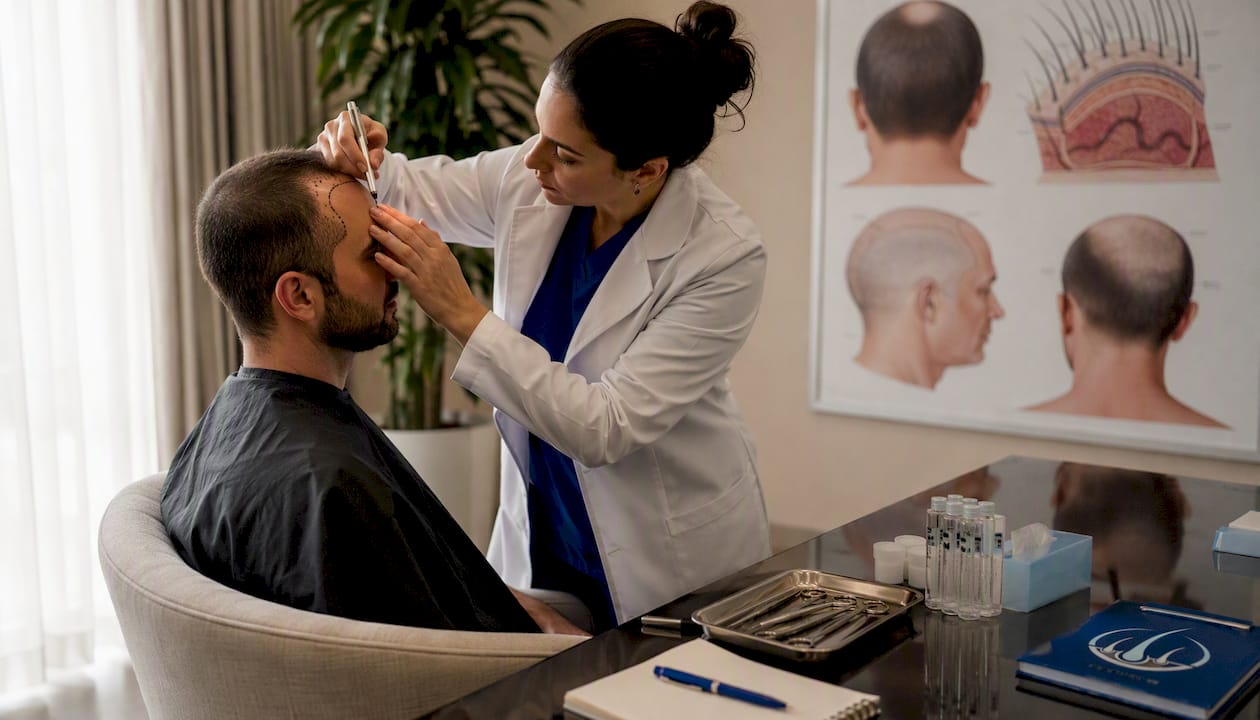
At Glasgowhairtransplantclinics, no technique is recommended before a full assessment is complete. The process begins with a free consultation, either online or face-to-face, where the surgeon reviews medical history, hair-loss pattern, and family history before any discussion of method.

The clinical assessment covers:

  • Donor-area mapping to establish total available graft supply.
  • Scalp laxity testing to determine FUT suitability and likely scar outcome.
  • Photographic planning to design the recipient area and set realistic density expectations.
  • A frank discussion of long-term loss progression and how it affects the treatment plan.

All surgeons at Glasgowhairtransplantclinics are registered on the GMC register. Clinics are registered with the CQC and HIS, which patients can verify independently. Before-and-after results are available in the patient results gallery, and the clinic’s consultation process is described in detail for patients who want to understand what to expect before they attend.


Key takeaways

FUE suits most UK patients as a default because of its scar profile and hairstyle flexibility, but FUT and combination approaches remain the stronger choice for patients needing high graft counts or planning multiple lifetime sessions.

Point Details
FUE is the default for most patients Dot scars suit short hairstyles; faster recovery; no linear scar.
FUT delivers higher single-session graft counts Strip harvest concentrates follicles in the central safe donor zone, supporting larger procedures.
Graft survival is comparable with skilled teams Some studies cite a 3–8% FUT advantage; experienced FUE practitioners narrow this gap.
Combination FUT then FUE maximises lifetime supply Sequential use of both techniques can yield several thousand additional hairs versus FUE alone.
Glasgowhairtransplantclinics offers both methods Free consultations at CQC and HIS-registered clinics with GMC-registered surgeons determine the right approach for each patient.

Why surgeon choice and donor planning matter more than technique labels

The strip vs FUE debate has been running for two decades, and the honest answer is that neither technique is universally superior. What the evidence actually shows is that outcomes are broadly equivalent when graft counts are matched and the surgical team is skilled. The variable that separates good results from poor ones is not the method on the consent form; it is the experience of the surgeon, the rigour of the donor assessment, and the honesty of the pre-operative conversation.

What concerns me about how this decision is often framed is the tendency to treat FUE as automatically the modern, better option simply because it is more widely marketed. FUE is technically demanding. Literature is explicit that high-volume FUE carries a steep learning curve and a real transection risk in less experienced hands. A patient who chooses FUE at a clinic where technicians perform extraction unsupervised may get a worse outcome than they would have from a well-executed FUT at a properly regulated facility.

The other underappreciated point is time horizon. A 28-year-old with early-stage loss is not just making a decision for today; they are making a decision that shapes what is possible at 38, 45, and beyond. Treating the donor area as a finite resource from the first consultation, rather than an afterthought, is what separates genuinely patient-centred planning from a transactional procedure.

Neither technique is the answer. The right surgeon, the right plan, and the right clinic are.


Glasgowhairtransplantclinics: personalised hair restoration with a free consultation

Glasgowhairtransplantclinics offers both FUE and FUT procedures, alongside PRP therapy and Scalp Micro Pigmentation, at CQC and HIS-registered clinics in Glasgow, Newcastle, and other UK locations. Every treatment plan starts with a free consultation, online or face-to-face, where a GMC-registered surgeon assesses your donor area, discusses your goals, and recommends the approach that fits your long-term needs, not just the current session.

Transparent pricing, written aftercare plans, and a before-and-after gallery are available before you commit to anything. For patients weighing up costs, the hair transplant pricing page sets out current rates clearly. To speak with a surgeon or book your free assessment, visit the clinic locations page and find the nearest Glasgowhairtransplantclinics site to you.


Further reading and useful sources

The sources below are worth consulting directly, whether to verify a clinical claim, check a surgeon’s registration, or read the primary evidence behind the FUE vs FUT comparison.

  • Hair transplant — NHS : The NHS overview of both FUE and FUT procedures, including what to expect, risks, and how to find a qualified surgeon in the UK. A reliable starting point for any patient new to the topic.
  • ISHRS: FUE vs FUT and maximising the hair graft : The International Society of Hair Restoration Surgery’s guidance on framing the FUE vs FUT decision as a donor-management strategy. Authoritative and regularly updated.
  • Effect of follicular unit extraction on the donor area — PMC : A peer-reviewed analysis of FUE’s impact on the donor zone, covering transection risk, learning curve, and comparative outcomes. Useful for understanding the evidence behind technique comparisons.
  • ISHRS combination FUT/FUE graft availability study : The side-by-side study examining how combining FUT and FUE across sessions can increase lifetime graft availability. Relevant for patients considering long-term planning.
  • GMC register : The General Medical Council’s public register, where patients can verify any UK surgeon’s registration status before proceeding with a procedure.

Source What it covers Why it matters
NHS hair transplant page Procedure overview, risks, finding a surgeon Neutral, authoritative UK patient information
ISHRS FUE vs FUT guidance Donor-management framing, technique selection Leading professional society position
PMC FUE donor area review Transection risk, learning curve, comparative outcomes Peer-reviewed clinical evidence
ISHRS combination study Lifetime graft yield from FUT/FUE sequencing Evidence base for combination planning
GMC register Surgeon registration verification Independent trust check for UK patients

This article provides general information about hair transplant techniques and is not a substitute for professional medical advice. Consult a GMC-registered surgeon to discuss your individual suitability, risks, and expected outcomes before proceeding with any procedure.

Recommended

By Dr Harpreet Kalra August 2, 2026
Discover the hair transplant cost in Glasgow: understand pricing, what’s included, and how to choose the right clinic for your procedure.
By Dr Harpreet Kalra August 1, 2026
Explore your options for hair transplant finance in the UK. From clinic plans to loans, find the best way to fund your procedure.
By Dr Harpreet Kalra July 31, 2026
Discover the key hair loss causes in men and learn how to address them effectively. Take action to restore your confidence today!
By Dr Harpreet Kalra July 30, 2026
Discover the common hair loss mistakes men make and learn how to avoid them for healthier hair. Act now to preserve your follicles!
By Dr Harpreet Kalra July 29, 2026
Discover what hair transplant follow-up care entails. Learn essential tips to protect your grafts and ensure your recovery is smooth.
By Dr Harpreet Kalra July 28, 2026
Uncover the hidden costs of a hair transplant explained. Discover how to avoid unexpected expenses and get the most value for your money.
By Dr Harpreet Kalra July 27, 2026
Discover what is beard follicle transplantation and how it can permanently enhance your beard. Learn about the procedure and expert clinics today!
By Dr Harpreet Kalra July 27, 2026
Learn about scarring alopecia explained in this comprehensive UK patient guide. Discover its causes, types, and implications for hair loss.
By Dr Harpreet Kalra July 25, 2026
Discover what hair loss stabilisation means and how it halts thinning. Learn key markers and achieve your treatment goals effectively.
By Dr Harpreet Kalra July 24, 2026
Discover what causes patchy hair loss and learn about conditions like alopecia areata and traction alopecia. Get the insights you need!
Show More