






Recovery has two separate meanings. The first is wound healing: redness, tenderness, crusts and swelling settling after surgery. The second is cosmetic recovery: the transplanted hair shedding, starting a new growth cycle and gradually becoming long and thick enough to change the way the scalp looks. The first is measured in days and weeks. The second takes months.
This distinction prevents a common misunderstanding. A scalp can be healed enough for normal daily life long before the transplanted follicles have produced a visible result. Equally, a patient can look tidy after ten days and still need to protect the scalp in the way their surgeon has advised.
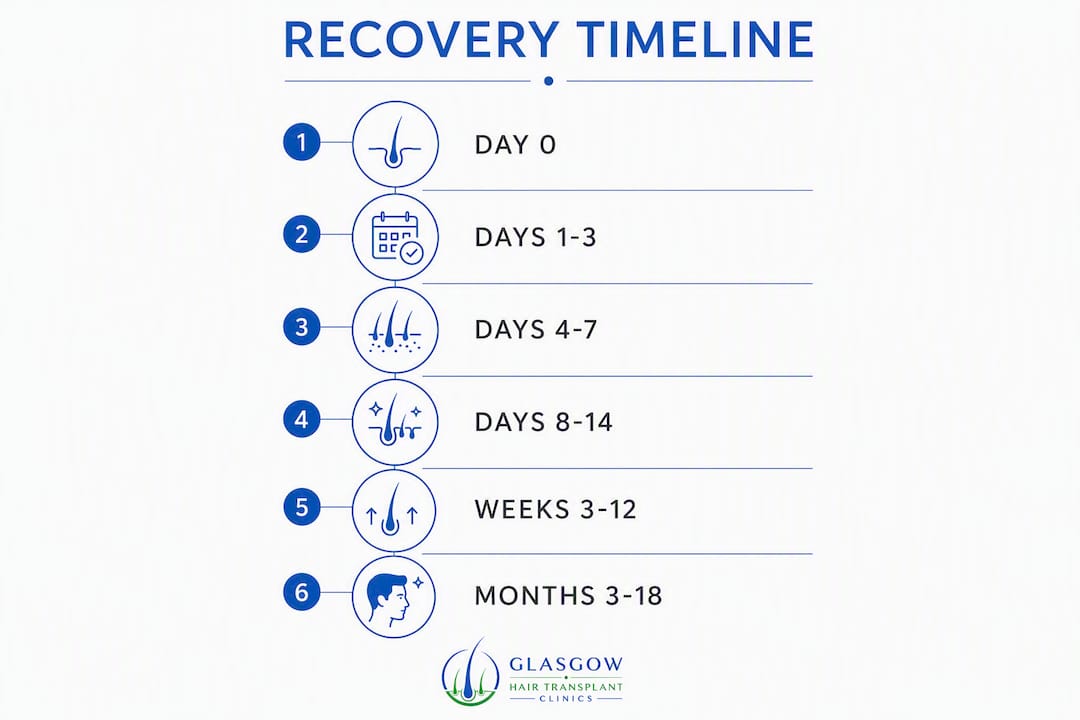
Hair transplant recovery timeline
Procedure day
Redness, pinpoint crusting and tenderness are common, and the donor area may be dressed. Travel home safely, keep the recipient area away from contact and follow the instructions supplied for the first night.
Days 1–3
Crusts become clearer and swelling can move towards the forehead or around the eyes. Do not rub, scratch or press the grafts. Use only the sprays and medicines you were instructed to use.
Days 4–7
The donor area starts to settle, although the recipient area can still look red and scabbed. Begin washing only on the date and with the method set out in your written aftercare plan.
Days 8–14
Crusts usually loosen and the scalp begins to look less obviously treated. Do not pick persistent crusts. FUT patients may still have a wound or sutures that need review.
Weeks 2–8
Many transplanted shafts shed, so the scalp can look similar to or temporarily thinner than it did before surgery. Shedding a shaft is different from losing the transplanted follicle. Contact the clinic if you are unsure.
Months 3–4
Early hairs may begin to appear and can look fine or uneven. It is too soon to judge density because different follicles enter growth at different times.
Months 6–9
Coverage becomes easier to assess as more hairs emerge and the earlier growth gains calibre. Consistent progress photographs are more useful than checking for a change every day.
Months 12–18
Most scalp results mature through this period, although crown work can take longer than frontal work. The final review should consider growth, density, the donor area's appearance and any continuing native hair loss.
The NHS hair-transplant guidance also separates early recovery from the much longer period needed for a result to develop. No online calendar can tell an individual patient that a symptom is normal. When something does not match the instructions you were given, contact the treating clinic.
The first 24 hours and first fortnight
The first night
The recipient area contains newly placed grafts and should not be pressed against a pillow, headrest, clothing or a tight hat. Sleep in the position advised by the clinic. Some patients are told to keep the head elevated to help with swelling, but the exact duration should come from the written plan rather than a generic internet timetable.
Do not drive if medication, tiredness or the effects of the procedure could impair you. Arrange transport before treatment day. A small amount of spotting from the donor area can occur, but persistent bleeding needs advice.
Days 1 to 3
Redness, tenderness, small crusts and a tight feeling can occur. Swelling may appear on the forehead and sometimes around the eyes. That can be part of normal early healing, but rapidly increasing swelling, breathing difficulty or an allergic-type reaction is not something to watch at home.
Use saline spray, shampoo, pain relief or other medicines only as directed. Routine antibiotics are not required for every patient, so the article does not treat them as a standard part of recovery. If they have been prescribed for you, follow the label and the clinician's instructions.
Washing and crusts
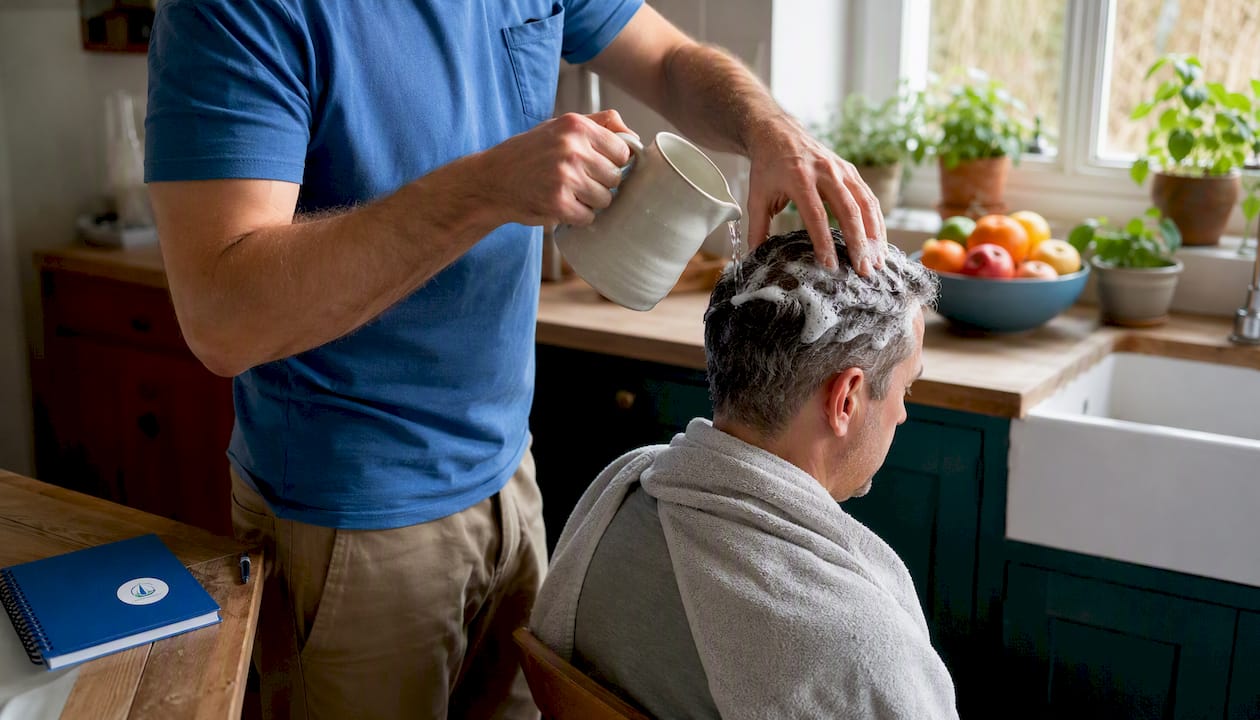
Clinics use different washing protocols. Some begin a gentle wash within the first few days; others use a different schedule. Start on the date Dr Kalra gives you. The consistent principles are low pressure, clean hands, lukewarm water and no scratching or forceful rubbing of the recipient area while it is healing.
Crusts normally loosen as the scalp is washed. Pulling them away early can also pull on hair shafts and irritate the skin. If crusting remains after the date by which you were told it should have cleared, ask the clinic for instructions instead of increasing pressure yourself. The detailed Glasgow hair transplant aftercare guide explains the clinic's approach.
Does FUE recover faster than FUT?
Both methods create a recipient area containing implanted grafts, so early care of that area is similar. The difference is at the back of the scalp.
FUE removes follicular units through many small circular incisions distributed across the donor region. It avoids one continuous linear wound, but it is not scarless. Tenderness, small crusts and temporary redness can occur where the units were removed.
FUT removes a narrow donor strip and closes the area as a linear wound. The donor site can feel tighter or sorer and may need suture care or removal, depending on the closure used. Returning to strenuous exercise can also be more conservative because tension across the healing wound matters.
The procedure name alone does not set your return-to-work date. The size of the operation, the job you do, the amount of swelling and your own healing response all affect it.
Shedding, the quiet phase and new growth
Many patients shed some or much of the visible transplanted hair during the early weeks, but not everybody sheds in the same way. During the usual post-transplant shedding phase, the visible shaft is released while the transplanted follicle remains beneath the skin.
This can be unsettling because the hair may look better immediately after surgery and then appear thinner again. It does not provide an early measurement of the final result. Read the clinic's separate guide to hair-transplant shedding and shock loss for the difference between shaft shedding, native-hair shock loss and donor overharvesting.
The next stage is often visually quiet. Early growth commonly becomes noticeable from around the third or fourth month, although timing varies. New hairs can be fine, wiry or uneven at first. More useful cosmetic change develops as additional follicles start growing and the earlier hairs become longer and thicker.
Frontal and hairline work is often easier to judge earlier than a broad crown transplant. The crown covers a larger circular surface and follows a whorl, so maturation can extend towards the later end of the 12-to-18-month range.
Work, exercise, hats, travel and haircuts
Returning to work
A desk-based job and a dusty, physical job are not equivalent. Some patients feel able to work from home within a few days, although redness and crusting may remain visible. Manual work, protective headwear, heat, dust and a raised heart rate can justify more time away. Plan leave around the actual role, not an average quoted online.
Gym and sport
Exercise restrictions protect against bleeding, friction and accidental impact during early healing. Light walking and heavy lifting do not carry the same risk. Contact sport, heading a football and helmets add another layer because the scalp can be struck or compressed. Resume each activity only when the clinic clears it. This is particularly relevant to players trying to fit surgery between seasons.
Hats and helmets
A hat is only useful if it does not touch or drag across the recipient area. Tight caps, hard hats and sports helmets should wait until the grafts and skin are ready. Ask the clinic to look at the type of headwear you need for work if returning depends on it.
Travel and sun
Arrange the first review before booking long or complicated travel. Keep any allowed aftercare products accessible and protect the scalp from direct sun in the way you were advised. Do not apply a product to healing grafts simply because it is marketed as gentle; confirm when sunscreen or styling products can restart.
Haircuts
The donor and recipient areas can be ready for trimming at different times. Clippers introduce contact and vibration, while scissors can be used without running a guard across the skin. Ask which area can be cut, with which tool and from what date.
What is expected, and when should you call?
Early redness, crusts, mild tenderness, itching, temporary altered sensation and some swelling can occur after hair-transplant surgery. They should generally move in the right direction. A change that is becoming worse rather than settling deserves attention.
Contact the treating clinic promptly if you have increasing pain, persistent bleeding, spreading redness or heat, thick discharge, a fever, rapidly increasing swelling, a wound opening or any symptom that concerns you. Seek urgent medical help for severe symptoms such as breathing difficulty, collapse or a serious allergic reaction.
Do not start leftover antibiotics, steroid cream or another person's medication. Photographs can help the clinical team assess a visible change, but they do not replace an examination when one is needed.
Recovery is not the same as preventing future hair loss
A transplant moves selected donor follicles. It does not stop untreated native hair elsewhere from thinning. A technically successful result can therefore look less complete later if the surrounding pattern progresses. That is why the consultation should consider the donor supply, the likely future pattern and whether non-surgical management is appropriate.
Progress photographs should use the same lighting, distance, hair length and angle. Comparing a wet, harshly lit month-three image with a styled month-six image creates a misleading impression in either direction. The clinic's full recovery and growth timeline and patient results provide further context.
Hair transplant recovery FAQs
How long does a hair transplant take to heal?
The most visible early healing usually occurs during the first one to two weeks. That does not mean the result is complete. Growth and maturation continue for roughly 12 to 18 months, with individual variation.
When can I wash my hair?
Use the start date and method in your written aftercare instructions. Protocols vary, so a universal day quoted online should not override the advice from the team that performed your procedure.
Is transplanted-hair shedding normal?
Many patients shed visible transplanted shafts during the early weeks. The amount varies and not every patient follows the same pattern. If shedding is accompanied by worsening inflammation, discharge or another concerning symptom, contact the clinic.
When can I return to the gym?
That depends on the activity, the donor method and how the scalp is healing. Walking, heavy weights, swimming and contact sport should not be treated as one category. Follow the staged return supplied by the clinic.
When will I see the final result?
Early growth often becomes visible after several months. Meaningful change tends to build through the middle of the first year, and maturation may continue to 12–18 months. Crown procedures can sit towards the longer end.
Should FUE have no scars?
No. FUE avoids the single linear donor scar associated with FUT, but every extraction makes a small incision. The visibility of healed marks depends on punch size, skin response, extraction pattern, donor density and hair length.